
If you spend five minutes searching for hair restoration online, you will be bombarded with claims of the "Best Hair Transplant Method." Every clinic seems to have a proprietary acronym or a "revolutionary" new tool that promises magic results.
As a senior clinical researcher, I have a professional secret to share: The "best" method isn't a single tool; it is a clinical standard. At Cult Aesthetics, we don’t believe in marketing gimmicks. We believe in metrics.
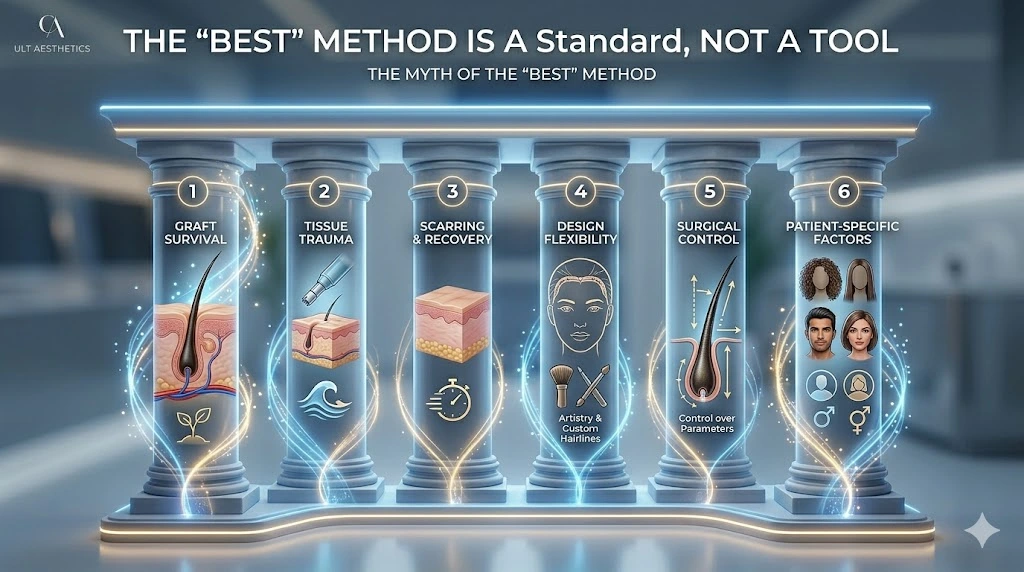
To truly determine if a method is world-class, it must be measured against six non-negotiable pillars of medical excellence. If a technique fails in even one of these, it isn't the "best"—it’s just a compromise.
A hair transplant is a biological relocation. Success is measured by how many of those relocated "permanent assets" are still standing at the 12-month mark.
Graft survival is influenced by two critical windows: The Extraction (pressure applied to the follicle) and the Holding Phase (was it protected by Bio-Chilled GFC storage?). Any method claiming superiority must prove it maximizes the "take" rate of every single graft.
Your donor area is your "Hair Bank Account"—it is a finite resource. A world-class method must be "surgical, not industrial." High-trauma methods leave the donor area looking moth-eaten. The "best" method ensures extraction sites are so small that even a short haircut won't reveal the surgery.
In the high-paced environment of Delhi and NCR, "social downtime" is a major concern. Evaluating a method means looking at Healing Speed and Inflammation Control. Does the protocol utilize Leukocyte-Poor formulations to minimize post-op swelling?
A "wall of hair" is not a hairline. The "best" method allows the surgeon to mimic nature’s randomness, placing single-hair grafts at the front for a soft transition and working around native hair to prevent the Island Effect.
For long-term density, we utilize our 12-Month Biological Maintenance Calendar to ensure the new design integrates perfectly with your existing hair.
To achieve a result where you look like you were born with it, the surgeon must have absolute control over Angle, Direction, and Depth. If a method relies on a machine that "automates" these decisions, it is no longer the best—it is simply the fastest.
There is no "Magic Bullet." The best method is adaptive—changing based on gender (female hairlines require different logic), hair texture (curly vs. straight), and skin type. It must be tailored, not mass-produced.
The Cult Aesthetics Verdict
At Cult Aesthetics, we don’t choose a method because it’s "trendy." We choose our protocols—combining the precision of DHT with the biological fuel of GFC—because they meet all six of these standards.
The method is just the tool. The standard is what creates the result. Don't just take our word for it—view our documentation of excellence in our latest 220-260 Case Study Gallery.
You’ve invested in a permanent change. We’ve invested in the technology to make sure that change is flawless.
Method Scorecard: The 6 Pillars of Excellence
| The Clinical Pillar | Standard FUE | Direct Hair (DHT) | Cult Aesthetics Protocol |
|---|---|---|---|
| 1. Graft Survival Short & Long term yield | Variable (85-90%). Higher risk of "Stun" loss. | High (90-95%). Reduced out-of-body time. | Elite (97%+). Bio-Chilled GFC eliminates "Reperfusion Stress." |
| 2 & 5. Surgical Control Angle, Direction, Depth | Moderate. Often relies on pre-made slits. | High. Simultaneous extraction & placement. | Absolute. Hand-calibrated depth & 100% Natural Directional Control. |
| 3. Tissue Trauma Recovery & Scarring | Moderate. 10-14 days social downtime. | Low. 7-10 days social downtime. | Minimal. LP-GFC reduces swelling; 5-7 days recovery. |
| 4 & 6. Suitability Design & Flexibility | Generic. Struggles with fine hair textures. | Flexible. Good for male pattern density. | Adaptive. Mastered for Female, Grey, and Fine-texture hair cases. |