
Quick Answer: Dr. Gaurav Solanki is a hair transplant surgeon based at Cult Aesthetics in Sector 46, Gurgaon. He performs FUE, DHI, beard transplant and corrective hair restoration surgery, along with non-surgical PRP, GFC and medical hair-fall management. Patients across Delhi NCR — and from more than a dozen countries — consult him for natural hairline design, high-Norwood reconstruction and second-opinion repair work.
Surgeon-led hair restoration. Twelve years of operative experience. Over 450 documented cases. Every hairline planned and performed personally — never delegated to a technician.
- 12+ years of operative experience
- 450+ documented hair transplant cases
- 20+ surgeries every month · Sector 46, Gurgaon
Why this practice exists
Most patients walk into a hair transplant consultation already convinced they need surgery. They have spent months — sometimes years — watching the hairline move back, reading forums, looking at clinic ads, comparing graft prices.
Dr. Gaurav Solanki has spent the last twelve years quietly insisting on a different conversation. Not how many grafts? but should this be a surgery at all, and if it is, what kind, when, and what are we protecting in the donor area for the next twenty years?
He trained as a Cosmetic Oral and Maxillofacial Surgeon — the surgical specialty that handles the most demanding facial reconstructions, where a millimetre changes a face. That background shapes how he plans a hairline. Hair restoration, for him, is not a graft-counting exercise. It is facial design with living tissue that has to keep working for decades.
Cult Aesthetics was built around that idea. The clinic in Sector 46, Gurgaon, operates on roughly twenty patients a month — small by industry standards on purpose. Every consultation is with him. Every plan is drawn on his iPad with the patient watching. Every hairline is marked by him on procedure day. The technical team he works with has been with the clinic for nine years, which matters more than it sounds — long-term technicians extract and place grafts with a consistency that is impossible to fake.
Patients arrive with very specific fears. “Will people know?” “Am I being sold a surgery I don’t need?” “What happens if I lose more hair later — will the transplant look stranded?” “Can a bad transplant from somewhere else be fixed?” These are the conversations that fill the first hour of every consultation. The answers are not the same for everyone, which is the point.
Five principles that shape every plan
Stated plainly. Repeated in every consultation. Visible in every result.
- Hair transplant is planning, not just implantation. What separates a good result from a fake one is decided long before any incision. Hairline shape, density gradient, angle, donor-area economy, future-loss insurance — all of that is settled on paper. The procedure is the easy part once the plan is right.
- A good result should not announce itself. If anyone notices the transplant, the design was wrong. Natural results sit on the face the way the patient’s own hair would have, including the imperfections — soft front line, irregular spacing, single-hair grafts at the leading edge.
- The donor area is finite — treat it like a savings account. There are only so many follicles at the back and sides of the scalp. Over-harvesting in the first surgery leaves nothing for the second. Plans are written assuming the patient may need another procedure in ten years, so the donor area is rationed accordingly.
- Medical hair-fall control is not optional. Transplanted grafts are permanent, but the native hair around them is not. Without minoxidil, finasteride or alternative medical management — chosen for the individual — the patient watches their original hair thin around stable grafts. That looks worse than untreated baldness. Medical management is half of every plan.
- Every hairline should fit the patient who will have it for thirty years. Age, face shape, donor density, family pattern of loss, profession, lifestyle — these decide where the hairline goes, not what the patient saw on Instagram. A twenty-eight-year-old who wants a teenage hairline is being set up for a stranded transplant by his fifties.
A transplant is a one-way decision. The grafts you place at twenty-eight are still on your head at fifty-eight. The hairline you design has to age with the patient.
Dr. Gaurav Solanki
Procedures performed personally by Dr. Gaurav Solanki
Each card below links to a deep service guide on cultaesthetics.in. Where a separate page does not yet exist, the procedure is discussed in detail during consultation.
FUE Hair Transplant
Follicular Unit Extraction. The gold standard at Cult Aesthetics for most Norwood 2–5 cases. No linear scar, faster recovery, suitable for short hairstyles.
DHI Hair Transplant
Direct Hair Implantation using a Choi implanter pen — recipient incisions and graft placement happen in one motion. Useful for unshaven hairline cases and dense crown work.
Sapphire FUE
FUE with sapphire-blade recipient sites — narrower incisions, denser packing without compromising blood supply. Used selectively where the design benefits from it.
Beard Transplant
Single-hair graft work for jawline, moustache, sideburn and goatee restoration. Designed to look organic — varied angle, varied density.
Crown Restoration
Vertex / crown work is one of the most graft-hungry zones on the scalp. Done carefully, with realistic density targets and a medical plan to slow further loss before more crown surgery is considered.
High Norwood Cases
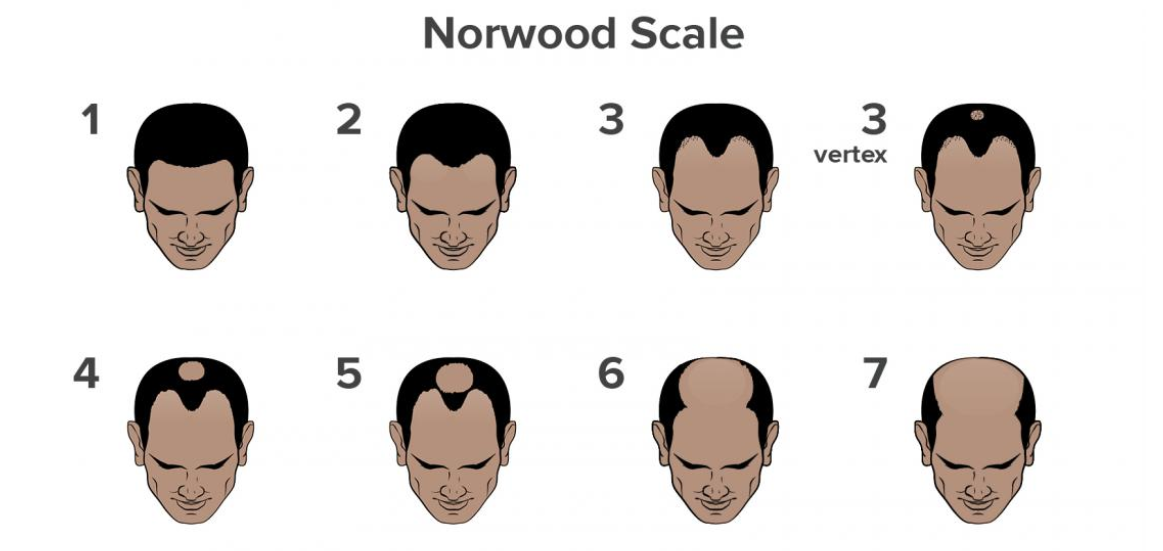
Norwood 5, 6 and 7 patients need multi-session planning, careful donor extraction, and honest conversations about realistic coverage. We do not promise full density on a fully bald scalp. We do plan a hairline and frontal third that restores facial framing first.
Female Hair Restoration
Diffuse thinning, traction alopecia, post-partum loss, and female-pattern hair loss are handled with a different lens — medical management first, surgical only when appropriate.
PRP & GFC Hair Treatment
Platelet-Rich Plasma and Growth Factor Concentrate are biocellular treatments used to slow loss, support transplanted grafts post-surgery, and treat early-stage thinning before it requires surgery.
Medical Hair-Fall Management
Diagnostic workflow, scalp imaging, blood-panel review and a medical plan — minoxidil, finasteride, dutasteride where indicated, nutritional correction, scalp inflammation control. The first conversation, not the last resort.
Repair / Corrective Hair Transplant
Second-opinion work on transplants done elsewhere — pluggy hairlines, depleted donor areas, scarred recipient zones. Honest assessment of what can and cannot be fixed.
Documented results — not stock images
Every case in our galleries belongs to a real patient who consented to publication. Where possible, the gallery includes the consultation photographs, the planned graft count, the on-the-table extraction notes, and the same patient’s hair at three, six, nine and twelve months.
Galleries are organised by Norwood grade so you can find cases that resemble your own situation:
- All cases — Before-and-after gallery
- Early-stage loss — Grade I and II results
- Moderate loss — Grade III and IV results
- Advanced loss — Grade V and VI results
- Beard work — Beard transplant cases
Results are shown without artificial density enhancement, post-production thickening, or filtered lighting. If a result looks unfinished, that is because hair grows on its own schedule — twelve months, sometimes fifteen.
“Since 8 months from my hair transplant, results are good and more improvement is expected in the upcoming months. Doctor and staff were good and cooperative in every aspect — I can call or chat any time.”
Watch Dr. Gaurav explain the work, in his own words
Four hand-picked clips from the @cultaesthetics channel — what to watch out for before surgery, what determines success, the documented results, and why international patients travel to Gurgaon.
What patients say about Dr. Gaurav Solanki
Verified Google reviews from patients operated on personally by Dr. Gaurav Solanki at Cult Aesthetics, Sector 46, Gurgaon. Each review is publicly visible on Google Maps and reflects the patient’s own words.
“I was nervous before my hair transplant, but Dr Gaurav Solanki and the team made me feel comfortable throughout the journey. The procedure was painless, recovery was smooth and the results are outstanding. It doesn’t even look like I had a hair transplant — it looks completely natural. Truly life-changing experience.”
— Divyansh Sharma · Verified Google Review
“Got my hair transplant done at Cult Aesthetic Gurgaon by Dr. Gaurav Solanki and I am extremely happy with the result. The team was very professional and the results look absolutely natural. Best decision I made — highly recommend them for anyone thinking about hair transplant.”
— Vishal Hooda · Verified Google Review
“What a fantastic result for my hair transplant with Dr Gaurav Solanki from Cult Aesthetics Gurgaon clinic. Existing hair have become better because of PRP and GFC treatments. All the clinic staff is very polite and cooperative. I came all the way from Fatehabad, Haryana to Dr Gaurav for the procedure and am extremely satisfied.”
— Rajat Arora · Travelled from Fatehabad, Haryana
Behind the scenes at Cult Aesthetics
Follow the day-to-day on Instagram — patient transformations, hairline-design reels, post-op walk-throughs, myth-busting clips, and what an actual operating day looks like.
Channel: @cultaestheticsbyenhance
Professional background
Dr. Gaurav Solanki — Cosmetic Oral and Maxillofacial Surgeon, founder and lead surgeon at Cult Aesthetics. Twelve-plus years of operative experience, with a clinical focus on hair restoration surgery and facial aesthetic procedures.
- LinkedIn: linkedin.com/in/dr-gaurav-solanki
- Clinic: Cult Aesthetics, 67 Residency Green, 3rd Floor, Jal Vihar Colony, Sector 46, Gurgaon, Haryana 122003
- Active across: Hair restoration, facial aesthetics, surgical planning, patient education through YouTube and Instagram.
Featured in — press & industry recognition
Dr. Gaurav Solanki has been featured in independent industry publications recognising his surgeon-first approach and contribution to ethical hair restoration in India.
- Prime Insights Magazine — 2026 edition: “The Most Renowned Hair Transplant Doctors Advancing Hair Restoration.” Full editorial interview covering surgical philosophy, technique selection, and the industry outlook for hair restoration in India. Read the full interview →
- LinkedIn editorial feature: “Dr. Gaurav Solanki: Leading the Charge in Ethical Hair Restoration and Patient-Centric Innovation at Cult Aesthetics.” View feature →
The questions patients actually ask
Will people know I had a hair transplant?
If the design is done well, no. The signs of a transplant are not the grafts themselves — they are the things that betray the procedure: a hairline drawn too low, too straight, or too dense for the patient’s age; pluggy spacing; thick hair behind a thin front. A naturally designed hairline is irregular at the leading edge, has single-hair grafts in the first row, gradates in density as it moves back, and respects the patient’s natural recession pattern. Done that way, even people who know you well do not notice.
How do I know if I actually need surgery?
Often you do not need surgery yet, and the most useful first consultation is the one that tells you that. Early or stable hair loss is usually better managed medically — minoxidil, finasteride or dutasteride where appropriate, scalp inflammation control, and sometimes PRP or GFC. Surgery becomes the right call when loss has stabilised, the area is large enough that medical management alone will not restore framing, and the donor area is healthy enough to support the plan. Dr. Gaurav will tell you directly if you are not yet a candidate.
What happens if I lose more hair later?
This is the most important question and the one most clinics avoid. Your native hair around the transplanted area may continue to thin over the next decade. If the surgery is planned without that in mind, the transplanted grafts end up looking stranded — an island of density on a thinning scalp. The plan we draw for you always assumes you may lose more hair. That means realistic graft placement, a hairline that ages, donor-area conservation for a potential second procedure, and a medical plan to slow native-hair loss starting from before surgery.
Can a bad hair transplant from somewhere else be repaired?
Sometimes, partially. The grafts that were placed cannot be moved, but a corrective plan can soften an unnatural hairline, fill the gaps that make the result look pluggy, and rebalance density. The honest constraint is the donor area — if it was over-harvested in the first procedure, the corrective options are smaller. Dr. Gaurav offers second-opinion consultations specifically for corrective work, with an upfront assessment of what is possible.
Why do some hairlines look fake?
Three reasons, almost always. The line is drawn too low or too straight for the patient’s face. The leading edge uses multi-hair grafts instead of single hairs, which creates the pluggy look. The density is uniform across the whole zone instead of gradating from softer at the front to thicker behind. Each of these is a planning decision, not a technique limitation.
Why is medical hair-fall control important after a transplant?
Because a transplant moves follicles, it does not stop hair loss. The grafts you transplant from the donor area are permanent, but the rest of your scalp is still subject to the same genetics. Without medical control, native hair continues to thin around the new grafts and the result looks worse over time. Minoxidil, finasteride or dutasteride — selected for your individual profile — are how we hold the line on the hair you still have.
Is PRP or GFC required after a hair transplant?
Required, no. Useful, often. PRP and GFC are biocellular treatments that support the graft survival environment, accelerate early growth, and help maintain native hair around the grafts. Whether they make sense for you depends on your case, your medical management plan, and your budget. Dr. Gaurav will tell you in the consultation whether they will meaningfully improve your outcome.
How many grafts will I need?
There is no answer to this without a scalp examination. The number depends on the area being treated, the density target, donor density, hair characteristics, and the future-loss plan. As a rough orientation: a hairline-only correction is often 1,500–2,000 grafts; a hairline plus mid-scalp 2,500–3,500; a fuller frontal third with crown coverage can require 3,500–5,000+ split across one or two sessions. Your actual plan will be written on your scalp diagram in the consultation, with the graft count justified zone by zone.
What makes a hairline look natural?
Position, shape, density gradient, and graft selection. The position has to suit the patient’s face and age. The shape has to be asymmetric and slightly irregular — natural hairlines are not drawn with a ruler. The density has to gradate from soft at the very front to denser behind. And the leading edge has to be built from single-hair grafts, not the multi-hair follicular units that go further back. When all four are right, the result is invisible.
How do I prepare for the consultation?
Bring your medical history (especially anything affecting clotting, healing or hair loss), a list of current medications, and any old photographs that show your hairline before the loss started. Stop minoxidil one to two weeks before consultation if you want a clean baseline reading. Come with questions, not requests — the goal of the consultation is to find the right plan, which may or may not involve surgery.
Hair restoration resources
Surgeon-authored guides on every aspect of hair transplant decision-making in Gurgaon and Delhi.
- ➜ Hair transplant in Gurgaon
- ➜ Hair transplant cost in Gurgaon — 2026
- ➜ Hair transplant cost in India — 2026
- ➜ FUE hair transplant in Gurgaon
- ➜ DHI hair transplant in Gurgaon
- ➜ GFC hair treatment in Gurgaon
- ➜ PRP hair treatment in Gurgaon
- ➜ Hair fall treatment in Gurgaon
- ➜ Beard transplant — Gurgaon
- ➜ Hair transplant for women
- ➜ Hair transplant in India for NRI patients
Where patients travel from to see Dr. Gaurav
Cult Aesthetics sits in Sector 46, Gurgaon — twelve minutes from DLF Phase 2, fifteen from Cyber City, and a thirty-to-forty-minute drive from South Delhi. Daily consultations cover patients from across Delhi NCR and weekly procedures cover fly-in patients from across India and abroad.
Regular catchment includes:
- Gurgaon — local patients from Sector 46, DLF Phases 1 to 5, Sushant Lok, Golf Course Road, Cyber City corridor.
- South Delhi — Hauz Khas, Greater Kailash, Saket, Vasant Vihar, Defence Colony.
- Other Delhi neighbourhoods — Janakpuri, Dwarka, Mayur Vihar, CP.
- NCR adjacencies — Noida, Faridabad, Ghaziabad.
- Other Indian metros — fly-in patients from Bangalore, Mumbai, Hyderabad, Chennai, Kolkata, Pune.
- NRI and international — patients from the UK, US, Australia, New Zealand, Canada, the GCC and across Africa choose Gurgaon for surgical quality and value.
Free pickup and drop on procedure day for NCR-resident patients. Partner-hotel rates for fly-in patients. A dedicated guide for international patients covering travel, stay and post-operative care is available on the NRI hair transplant page.
Start with a conversation, not a surgery
Not every patient needs a transplant. The first step is understanding whether surgery, medical treatment, or a combined plan is the right answer for you — and an honest consultation is how we find out.
Dr. Gaurav Solanki personally takes every consultation at Cult Aesthetics. Free thirty-minute slots are available in person at Sector 46 or over video for patients outside NCR.
Visit Cult Aesthetics — 67, Residency Green, 3rd Floor, Jal Vihar Colony, Sector 46, Gurgaon, Haryana 122003. Open Monday and Wednesday–Sunday, 10:00 am to 7:00 pm; Tuesday closed. Phone / WhatsApp: +91 99904 49555 · info@cultaesthetics.in.
Hair Restoration Resources
Surgeon-authored guides on every aspect of hair transplant decision-making in Gurgaon and Delhi.
- ➜ Hair Transplant in Gurgaon
- ➜ Hair Transplant Cost in Gurgaon 2026
- ➜ FUE vs DHI vs Sapphire — Surgeon's Guide
- ➜ PRP vs GFC vs Mesotherapy
- ➜ How to Choose a Hair Transplant Surgeon
- ➜ Hair Transplant Cost in India 2026
- ➜ FUE Hair Transplant Gurgaon
- ➜ DHI Hair Transplant Gurgaon
- ➜ GFC Hair Treatment Gurgaon
- ➜ PRP Hair Treatment Gurgaon
- ➜ Hair Fall Treatment Gurgaon
- ➜ Best Hair Transplant Clinic in Delhi
- ➜ Beard Transplant Gurgaon
- ➜ Hair Transplant in Delhi
Cult Aesthetics is led by Dr Gaurav Solanki, Hair Transplant Surgeon in Gurgaon. This page reflects his surgeon-led, evidence-based approach.