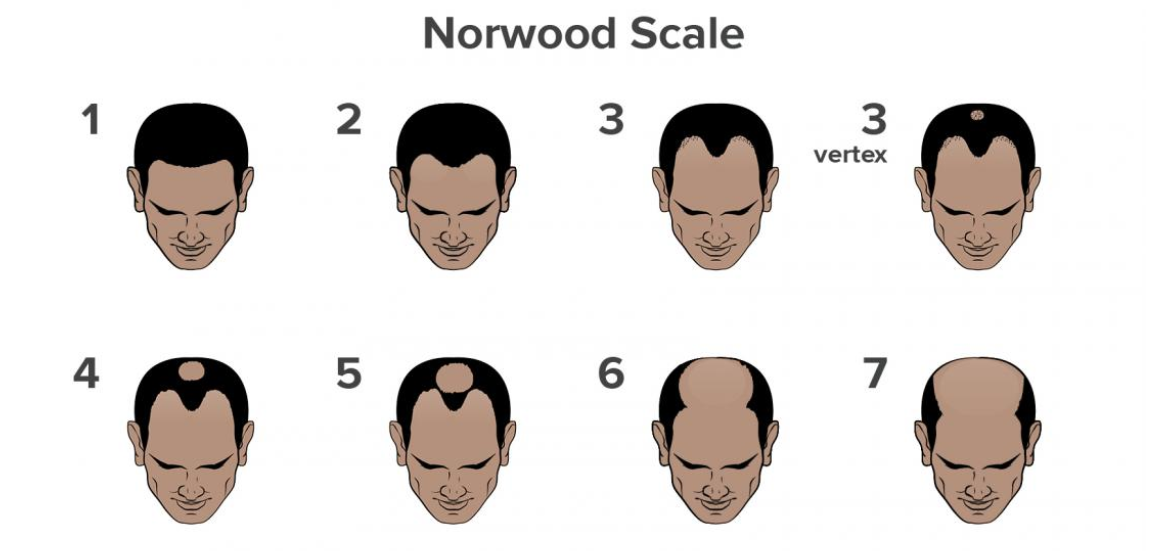

PRP (platelet-rich plasma) hair treatment uses a concentrate made from a small sample of your own blood, injected into the thinning parts of your scalp. At Cult Aesthetics in Sector 46, Gurugram, Dr Gaurav Solanki gives the PRP injections himself. The aim is to support hair that is thinning but still there, and to slow further loss. PRP does not grow hair on skin that is already bald. A session costs ₹5,000–₹12,000 plus 18% GST, and most people start with three sessions about a month apart.
TL;DR
- Best suited to: pattern thinning where fine, weakened hairs are still present. Other kinds of hair fall are assessed first.
- The visit: about an hour. Around 20 mL of blood is drawn, the scalp is numbed with local anaesthesia, and the injections take about 15 minutes.
- The course: usually three sessions about a month apart, a review at around three months, then maintenance every 3–6 months only if it is helping.
- The cost: ₹5,000–₹12,000 + 18% GST per session, covering the procedure and consumables. There is no consultation charge.
- The limits: results vary from person to person, and PRP cannot replace a hair transplant for areas that are already bald.
On this page
Who is PRP hair treatment suitable for?
PRP makes most sense when hair is thinning rather than gone. In pattern hair loss, follicles gradually shrink and produce finer, shorter hairs; doctors call this miniaturisation. PRP aims to support those weakening follicles. Where a follicle has stopped producing hair altogether, there is nothing left for PRP to work on.
At Cult Aesthetics, Dr Gaurav mainly considers PRP for male pattern thinning where miniaturised hair is still present. Women with thinning hair are assessed individually. Other kinds of hair fall, for example shedding that began after stress, an illness or a move to a new city, are looked at case by case. That history helps explain what is happening, but on its own it does not mean PRP is the right treatment. A full hair-fall assessment comes first.
PRP may be worth discussing if…
- your hair is thinning, but fine hairs are still present in that area
- examination shows a pattern-thinning picture
- you want a non-surgical option, often alongside medicines your doctor recommends
- you have had, or are planning, a hair transplant and want to look after the hair you still have
Assessment comes first, and PRP may be postponed or avoided, if…
- you have an active scalp infection, which needs treating first
- you have a platelet problem or a bleeding disorder
- you take medicines that affect bleeding, such as blood thinners (do not stop them on your own)
- you are pregnant or breastfeeding: as a clinic policy, Dr Gaurav generally avoids PRP at this time
- your hair loss is sudden or patchy, or you feel unwell
- the area is already bald, because PRP cannot regrow it
PRP is a treatment for thinning hair, not bald skin, and the first step is finding out why your hair is falling.
Who gives the PRP injections, and how is the PRP prepared?
At Cult Aesthetics, the PRP injections are given by Dr Gaurav Solanki himself; they are not handed to a technician. Dr Gaurav (MDS, Oral & Maxillofacial Surgery) is the clinic’s co-founder, lead surgeon and medical director.
About 20 mL of blood (roughly four teaspoons) is drawn from your arm. It is then prepared using a protocol Dr Gaurav has refined through his own experience with PRP. This page does not quote technical figures such as platelet concentration. If you would like to know how your PRP is prepared, ask him at your consultation.
Before the injections, the scalp is numbed with local anaesthesia. This keeps you more comfortable and lets Dr Gaurav place the PRP at the depth he intends. Scalp injections can still be uncomfortable even with anaesthesia, so you may feel the anaesthetic going in and some pressure. If you have ever reacted badly to a local anaesthetic, tell us beforehand.
The doctor who assesses you is the doctor who injects you, and local anaesthesia is used for comfort.
What happens during a PRP session?
Plan for about an hour at the clinic. The injections take around 15 minutes; most of the time goes into the check-in, preparing the PRP and numbing the scalp.
- Check-in and review. Dr Gaurav goes over your hair history, your medicines and your scalp. At a first visit, this is where he decides whether PRP suits you at all.
- Blood draw. About 20 mL of blood is taken from your arm.
- Preparation. Your PRP is prepared and your scalp is cleaned. If you use topical minoxidil, you usually do not need to stop it before the session.
- Local anaesthesia. The areas to be treated are numbed.
- Injections. Dr Gaurav injects the PRP into the thinning areas. This part takes about 15 minutes.
- Aftercare advice. You get your 24-hour aftercare instructions, and any medicine you need, before you go home.
One hour at the clinic, with about 15 minutes of injections given by Dr Gaurav under local anaesthesia.
How many PRP sessions will I need, and when will I know if it is working?
Most people start with three sessions about one month apart. At around three months, Dr Gaurav reviews how your hair has responded. If PRP is helping, you move on to maintenance sessions every three to six months. How often depends on how you respond and on how much further improvement is realistic for you.
| When | What usually happens |
|---|---|
| Month 0 | First session |
| Month 1 | Second session |
| Month 2 | Third session |
| Around month 3 | Review of your response |
| Every 3–6 months after that | Maintenance sessions, only if PRP is helping you |
This pattern is similar to the one the American Academy of Dermatology describes (monthly injections for three months, then every three to six months), and an Indian dermatology taskforce recommends at least three to five monthly sessions. Your own plan is set after assessment.
Results vary. Some people mainly notice less hair fall; others see little change. Your history matters too: if you have had PRP before, a new course may make less visible difference, and slowing further loss is the more realistic goal.
If PRP is not helping by the review, the plan is to reassess rather than keep adding sessions. That may mean looking again at the cause, adjusting medicines, or discussing other options, including a transplant if there are bald areas.
Noticing more hair fall after a session?
Do not assume it is harmless or simply part of the process. If shedding is new, keeps going or gets worse, contact us so Dr Gaurav can review it.
Three sessions, a review at about three months, and maintenance only if it is working for you.
What should I do before and after a PRP session?
Before your session
- Tell us about every medicine you take, including blood thinners, aspirin and painkillers. Do not stop prescribed medicines without advice from your prescribing clinician. Your treating clinician will give you a preparation plan that suits you.
- If you use topical minoxidil, you usually do not need to stop it before the session; your scalp is cleaned on the day.
- Tell us if you are pregnant or breastfeeding, have a bleeding or platelet problem, have a scalp infection, or feel unwell on the day.
For the first 24 hours after your session
24-hour aftercare checklist
- No hair oil, shampoo or lotion, and no head wash.
- No minoxidil. Restart it when Dr Gaurav tells you to.
- No heavy lifting, and no exercise that makes you sweat.
- If you have been given medicine for swelling or irritation, take it as prescribed.
Tell us about every medicine you take, and keep your scalp product-free and sweat-free for the first 24 hours.
What side effects can PRP cause, and when should I contact the clinic?
PRP is an injection treatment, so it is not risk-free. The effects reported most often in studies are short-lived: pain or tenderness, itching, headache, redness and swelling (review of PRP for hair regrowth). At Cult Aesthetics, mild swelling or irritation happens in some patients; if it is needed, Dr Gaurav prescribes medicine for it.
Serious problems are rarely reported, but they have been described in individual case reports. Allergy to local anaesthetic is uncommon (review of local anaesthetic allergy), and some people feel faint or light-headed for a short time around the injections. Tell us about any past reaction.
Contact the clinic if you notice
- pain, redness or swelling that is getting worse instead of better after the first day or two
- warmth, pus or a fever, which can be signs of infection
- bleeding that does not stop with gentle pressure
- hair shedding that is new, persistent or getting worse
Call or WhatsApp +91 99904 49555.
Get urgent medical help for
- difficulty breathing
- swelling of the lips, face or throat
- a widespread rash or feeling very unwell soon after an injection
These are rare, but they can be signs of an allergic reaction.
Expect some tenderness or mild swelling, and contact us if things get worse instead of better.
How much does PRP hair treatment cost in Gurgaon?
At Cult Aesthetics, a PRP session costs ₹5,000 to ₹12,000, plus 18% GST. The price depends on what you need and how many sessions your plan includes, which is why it is given as a range. You get an exact figure after your assessment.
Included in the session price
- the PRP procedure
- the consumables used in the session
Not included
- 18% GST, added to the session price
- supplements such as biotin, if they are recommended or prescribed for you. The clinic estimates these at about ₹1,000–₹1,500 a month; not everyone needs them.
There is no consultation charge. EMI options are available, and the terms are explained at the clinic.
| Per-session price | 3 sessions | 18% GST | Total |
|---|---|---|---|
| ₹5,000 | ₹15,000 | ₹2,700 | ₹17,700 |
| ₹12,000 | ₹36,000 | ₹6,480 | ₹42,480 |
This is simple arithmetic on the published range, not a package price. If PRP helps and you continue, maintenance sessions every three to six months are charged per session, so it is worth thinking about that ongoing cost before you start.
₹5,000–₹12,000 + 18% GST per session, with the procedure and consumables included and no consultation charge.
Is PRP an alternative to a hair transplant?
Not really, because they do different jobs. PRP aims to support the hair you still have. A hair transplant moves healthy follicles from the back and sides of your head (the donor area) to thinning or bald areas. Neither treatment creates new follicles, and your donor supply is limited, so a transplant redistributes the hair you have rather than adding to it.
If an area is already bald, PRP cannot replace a transplant there. If you have both bald areas and thinning hair, the two may be planned together: the transplant for the bald areas, and PRP for the thinning hair around them.
| PRP | Hair transplant | |
|---|---|---|
| Main aim | Support existing thinning hair and slow further loss | Move follicles from the donor area to thinning or bald areas |
| Can it cover bald areas? | No | Yes, within the limits of your donor supply |
| Who does what at Cult Aesthetics | Dr Gaurav gives the injections | Dr Gaurav plans the surgery, designs the hairline, extracts the grafts and makes the recipient sites; trained implanters place the grafts under his supervision |
| Anaesthesia | Local | Local |
| Course | Usually three sessions a month apart, then maintenance every 3–6 months if it helps | Usually one procedure; the final result of an FUE transplant takes about 12–18 months to show |
| Price basis | ₹5,000–₹12,000 + 18% GST per session | Per graft: FUE ₹60–90, DHI ₹75–120, + 18% GST (transplant cost in Gurgaon) |
How is PRP used around a transplant at Cult Aesthetics?
For transplant patients who choose it, Dr Gaurav’s usual schedule is one PRP session on the day of surgery, then one a month for the next three months, followed by a gap of three to six months depending on how your hair is doing. This is the clinic’s own, individualised approach. It is not mandatory, and it does not prove that PRP improves graft survival: the research on PRP alongside transplants is limited and varied (systematic review, 2025). PRP or GFC sessions can be included in a transplant plan here; your quote will say what is covered. You can read more about the procedure in our FUE hair transplant guide.
Where does GFC fit in?
GFC (growth factor concentrate) is also made from your own blood, but it is processed further to concentrate the growth factors released by platelets. The few studies comparing the two directly are small, and neither has been shown to be clearly better (systematic review, 2026). GFC follows a different schedule and price; see GFC hair treatment in Gurgaon, and Dr Gaurav can explain which, if either, suits you. In the video below he discusses the two treatments.
PRP looks after the hair you have, while a transplant moves hair to where it is missing. They can work together, but one cannot replace the other.
What other treatments might be considered alongside or instead of PRP?
PRP is often one part of a wider plan. Depending on the cause of your hair loss, Dr Gaurav may also discuss these options:
Medicines
Minoxidil applied to the scalp and finasteride, a prescription medicine mainly used in men, are widely used for pattern hair loss. Both need a doctor’s advice first.
Mesotherapy
A course of small scalp injections. See mesotherapy for hair loss.
Low-level laser therapy
A light-based treatment. See LLLT hair treatment in Gurgaon.
Hair transplant
For areas that are already bald, within the limits of your donor supply. See FUE hair transplant in Gurgaon.
For a side-by-side look at the evidence, read PRP vs GFC vs mesotherapy: evidence and uncertainty.
PRP usually sits inside a wider plan, and the right mix depends on what is causing your hair loss.
What does the research say about PRP for hair loss?
PRP has mainly been studied in androgenetic alopecia (pattern hair loss). Overall, the evidence points to a modest benefit for some people, with a lot of uncertainty.
- A 2024 systematic review in PLOS ONE pooled five small randomised trials (one used PRF, a related platelet preparation) that compared platelet injections plus topical minoxidil with minoxidil alone. Adding the injections gave a higher hair density at 5–6 months, but the certainty of the evidence was rated low to very low, and the authors noted that a difference of that size may not be clinically meaningful.
- A meta-analysis of ten randomised trials (Aesthetic Plastic Surgery, 2024) found that PRP increased hair density compared with control treatments, but it did not show a statistically significant increase in hair thickness.
- The American Academy of Dermatology lists PRP among the treatments a dermatologist may use for hair loss.
- Studies differ in how the PRP was prepared, how many sessions were given and how long people were followed, and most follow-up lasts months rather than years. That is one reason a study result cannot predict your own result.
Growth factors released by platelets are thought to influence hair follicles, but exactly how PRP works is not fully established (review, 2022). Laboratory findings are interesting, but they do not tell you what will happen on your scalp, so this page does not rely on them.
For a fuller appraisal of the trials, read Dr Gaurav’s review PRP for hair loss: what systematic reviews can and cannot show.
The research supports a modest, variable benefit, which is why your own response at review matters more than any average.
What results can I realistically expect from PRP?
“The main objective of PRP is to delay hair loss, not to give you new hairs.”
That is the honest starting point. Response varies from person to person: some people notice less hair fall, some feel their hair looks a little fuller, and some notice very little change. Dr Gaurav reviews your progress at around three months and weighs it against any treatment you have had before.
Before-and-after video
This short clinic video shows individual patients photographed before and after PRP and/or GFC sessions. The treatment differed between patients, and the video does not show a typical or guaranteed result.
What have patients said about PRP here?
These are individual patients’ own words from Google reviews. Experiences differ, and a review is not a promise of your result.
“Best hair loss service at Cult Aesthetics clinic in Gurgaon. I have done my 2 PRP sessions for hair. Excellent results.”
“Fantastic result for my hair transplant with Dr Gaurav Solanki at Cult Aesthetics Gurgaon. Existing hair have become better because of PRP and GFC treatments. All the clinic staff is very polite and cooperative. I came all the way from Fatehabad, Haryana to Dr Gaurav for the procedure and am extremely satisfied.”
“Got best results for the hair transplant done with Dr Gaurav Solanki at Cult Aesthetics Gurgaon. Very, very happy I come all the way from Moradabad to continue with my PRP sessions. Dr Gaurav is the best hair transplant in Gurgaon.”
Aim for slower hair loss and judge your response at the review, rather than expecting new hair.
How do I decide whether PRP is right for me?
- Find out why your hair is falling. A scalp examination and your history come first.
- If it is pattern thinning with fine hairs still present, PRP may be one option, often alongside medicines.
- If there are bald areas, discuss a hair transplant. PRP can support the thinning hair around them.
- If you have an infection, a bleeding or platelet problem, take blood thinners, or are pregnant or breastfeeding, the plan may change, PRP may wait, or another treatment may suit you better.
- If you start PRP, complete the first three sessions and the review, then continue only if it is helping.
Questions worth asking any clinic
- Who will give the injections?
- How is the PRP prepared?
- What does the session price include, and what is extra?
- How will my response be measured, and when?
- What happens if it does not help?
Get the cause checked, start with a clear plan and a review date, and continue only if PRP is genuinely helping.
What do patients often ask about PRP in Gurgaon?
Is PRP hair treatment painful?
Local anaesthesia is used to numb the scalp, so much of the discomfort is reduced. It is not painless: you may feel the anaesthetic going in and some pressure during the injections, and the scalp can feel tender afterwards.
How many PRP sessions will I need?
Usually three sessions about a month apart, followed by a review at around three months. If PRP is helping, maintenance sessions follow every three to six months; how often depends on your response.
When will I know if PRP is working?
Your response is reviewed at around three months. Results vary: some people mainly notice less hair fall, and some see little change. The main aim is to slow hair loss, not to grow new hair.
Can I go back to work the same day?
PRP does not need a hospital stay, and the restrictions last 24 hours: no hair oil, shampoo, lotion or head wash, no minoxidil, and no heavy lifting or sweaty exercise. If your work involves heavy physical effort, plan around that first day. Mild swelling or tenderness can happen.
Do I need to stop aspirin or blood thinners before PRP?
Do not stop prescribed medicines without advice from your prescribing clinician. Tell us about everything you take, including aspirin, blood thinners and painkillers, and your treating clinician will give you an individual preparation plan.
Should I stop minoxidil before PRP?
Usually not. Your scalp is cleaned on the day of treatment. Avoid minoxidil for the first 24 hours after the session, then restart it when Dr Gaurav tells you to.
Is PRP safe?
No injection treatment is risk-free. The effects reported most often are short-lived pain or tenderness, itching, headache, redness and swelling. Serious problems are rarely reported. PRP may be postponed or avoided if you have an active scalp infection, a platelet problem or a bleeding disorder, and the clinic generally avoids it during pregnancy and breastfeeding.
Can women have PRP?
Yes, women with thinning hair can be assessed for PRP. Dr Gaurav first looks at the type and cause of the hair loss, because PRP is not suitable for every kind of hair fall.
Can PRP regrow hair on a bald patch?
No. PRP works on hair that is still present. For areas that are already bald, a hair transplant may be discussed, within the limits of your donor supply.
Do I need PRP after a hair transplant?
It is not mandatory. For transplant patients who choose it, our usual schedule is a session on the day of surgery, monthly for the next three months, then every three to six months depending on your hair. Research has not proven that PRP improves graft survival.
How much does a PRP session cost, and is the consultation charged?
A session costs ₹5,000–₹12,000 plus 18% GST, including the procedure and consumables. There is no consultation charge. Supplements, if recommended, are extra.
What happens if PRP does not work for me?
The plan is to reassess rather than keep adding sessions. That may mean looking again at the cause, adjusting medicines or discussing other options, including a transplant if there are bald areas.
Is PRP better than GFC?
Neither has been shown to be clearly better; the few direct comparisons are small. GFC is processed further to concentrate growth factors and follows a different schedule. Dr Gaurav can explain which, if either, suits you.
PRP is a gradual, doctor-given treatment for thinning hair, with a review at about three months and a published per-session price.
How do I book a PRP consultation in Gurgaon?
There is no consultation charge. Dr Gaurav will assess your hair and tell you whether PRP is worth trying, and what else might help.
Cult Aesthetics, 67, Residency Green, 3rd Floor, Jal Vihar Colony, Sector 46, Gurugram 122003. Open Monday and Wednesday to Sunday, 10 am to 7 pm; closed on Tuesday.
If you have had PRP or other hair-loss treatment before, bring the details. It helps Dr Gaurav judge what to expect.
About this page: written for Cult Aesthetics using clinical information provided by Dr Gaurav Solanki, who performs PRP at the clinic. It is general information, not a diagnosis or a treatment plan for you. Last updated: 9 November 2026.
What Our Patients Say
Rated 4.9★ from Google reviews
“I was nervous before my hair transplant, but Dr Gaurav Solanki and the team made me feel comfortable throughout the journey. The procedure was painless, recovery was smooth and the results are outstanding.”
Divyansh Sharma · Google
“Best hair transplant in Gurgaon. My experience is wonderful with Dr Gaurav, satisfactory result. Highly recommend the Cult Aesthetics team.”
Sagar Yadav · Google
“I spent a long time researching before choosing this clinic, and my experience so far has been very positive.”
Shahrukh Ahmed · Google
Cult Aesthetics is led by Dr Gaurav Solanki, Hair Transplant Surgeon in Gurgaon. This page reflects his surgeon-led, evidence-based approach.
→ Does PRP actually work for hair loss? Read the surgeon-authored evidence review
Hair Restoration Resources
Surgeon-authored guides on every aspect of hair transplant decision-making in Gurgaon and Delhi.