
Quick answer: DHI hair transplant in Gurgaon costs ₹75–₹120 per graft depending on technique and graft count. At Cult Aesthetics in Sector 46, Dr. Gaurav Solanki performs graft extraction, designs and marks the hairline, and makes recipient-site slits using a sapphire blade; technicians perform forceps-based no-touch implantation. A typical 2,000–2,500 graft DHI case takes one full day and costs ₹1,50,000–₹3,00,000 all-inclusive, with results visible from month four and full maturation at twelve months.
What does DHI actually mean and why does the name keep changing?
DHI stands for Direct Hair Implantation. At Cult Aesthetics, Dr. Gaurav Solanki performs graft extraction, hairline design and marking, and recipient-site slits using a sapphire blade. Technicians perform forceps-based no-touch implantation. Cult Aesthetics describes this workflow as its clinic-specific modified DHI technique, developed by Dr. Gaurav Solanki and Cult Aesthetics.
The confusion in the Indian market is real. “DHI” is also a franchise brand name used by some clinic chains. Many clinics that advertise “DHI” are licensed franchisees following a fixed protocol, not surgeons designing your case from scratch. At Cult Aesthetics we do not use Choi pens: we use a no-touch forceps technique, a modification developed at Cult Aesthetics that minimises handling of each graft, without the franchise overhead. The result is the same biological process at lower cost, with a single surgeon (Dr. Solanki) accountable end to end.
How is DHI different from FUE in practice?
FUE and DHI share the extraction step: individual follicles are punched out of the donor area using a 0.8–1.0 mm rotary or sapphire punch. They split on what happens next.
| Step | FUE | DHI |
|---|---|---|
| Recipient site creation | Surgeon makes slits with blade/needle before placing grafts | Dr. Solanki makes each site; grafts placed with no-touch forceps |
| Time out of body for grafts | Longer (channels made first, then grafts placed in batches) | Shorter (extraction → implantation flow is continuous) |
| Shaving requirement | Full donor + recipient shave typical | Often only donor area shaved recipient can stay covered |
| Hairline density control | High surgeon controls angle and depth manually | Dr. Solanki creates recipient sites with a sapphire blade; technicians place grafts with no-touch forceps |
| Cost per graft (Gurgaon) | ₹60–₹90 | ₹75–₹120 |
| Best for | Larger sessions, heavy donor harvest, maximum cost-efficiency | Patients who can’t shave recipient area, small focused cases, eyebrow/beard |
Neither is universally “better.” The right technique depends on your case: hair loss grade, donor density, lifestyle constraints (can you shave your head?), and budget. A surgeon who recommends DHI for every patient is selling the brand, not the procedure.
How much does DHI hair transplant cost in Gurgaon in 2026?
DHI hair-transplant pricing varies by the plan agreed after assessment. Factors can include the treatment area, the estimated graft requirement, donor characteristics, hairline or crown planning, and clinic-specific services. A personalised quote should set out the proposed graft estimate, what is included, and any follow-up arrangements.
For background on the questions that can affect planning, see DHI hair-transplant cost factors.
This information is educational and does not replace an in-person assessment or a personalised quote. Before deciding, ask the clinical team to explain the proposed plan, alternatives, risks, aftercare and the basis of any estimate.
How is a DHI procedure performed at Cult Aesthetics?
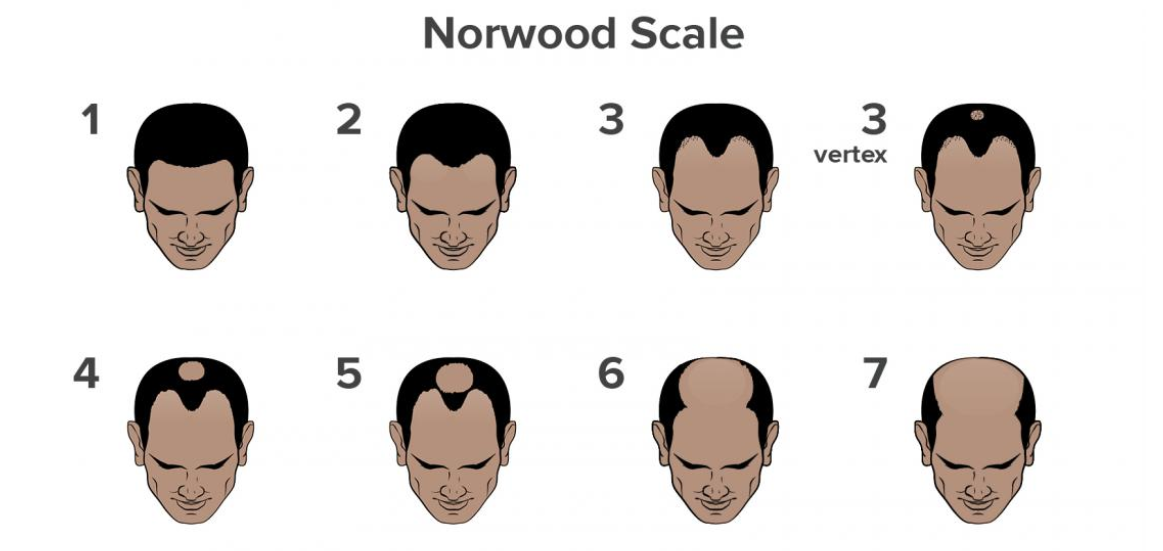
- Consultation and scalp analysis. Trichoscopy to assess donor density per cm², Norwood/Ludwig grading, hairline design with markings, blood panel review. About 45 minutes.
- Surgical planning. Graft count agreed in writing. Hairline drawn with patient input. Cost confirmed before any incision.
- Local anaesthesia. Long-acting block to donor and recipient. Most patients describe the only painful moment as the initial injection.
- Extraction. Dr. Gaurav Solanki performs graft extraction. Each follicle is graded under magnification and stored chilled in HypoThermosol.
- Implantation with no-touch forceps. Technicians implant each graft using the forceps-based no-touch technique into the recipient sites prepared by Dr. Solanki. Hairline first (single-hair grafts), then mid-scalp (two-hair grafts), then crown if applicable.
- Closure and post-op briefing. No sutures. Bandage only on donor. Written aftercare with WhatsApp access to Dr. Solanki for 30 days.
Before & after real cases at Cult Aesthetics
Three recent patient outcomes by Dr. Gaurav Solanki. Photos taken at the milestone shown under each image. All patients consented for publication.
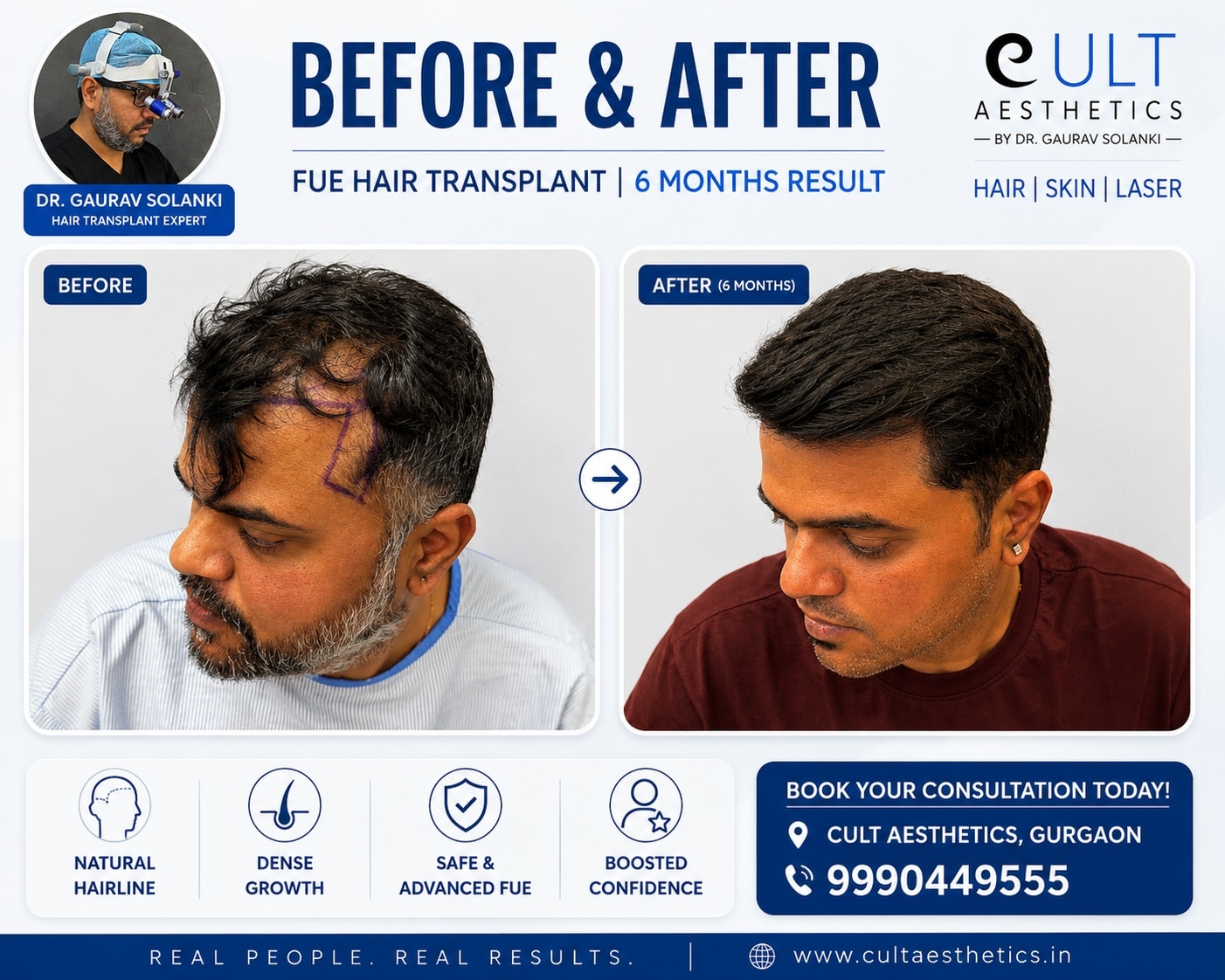
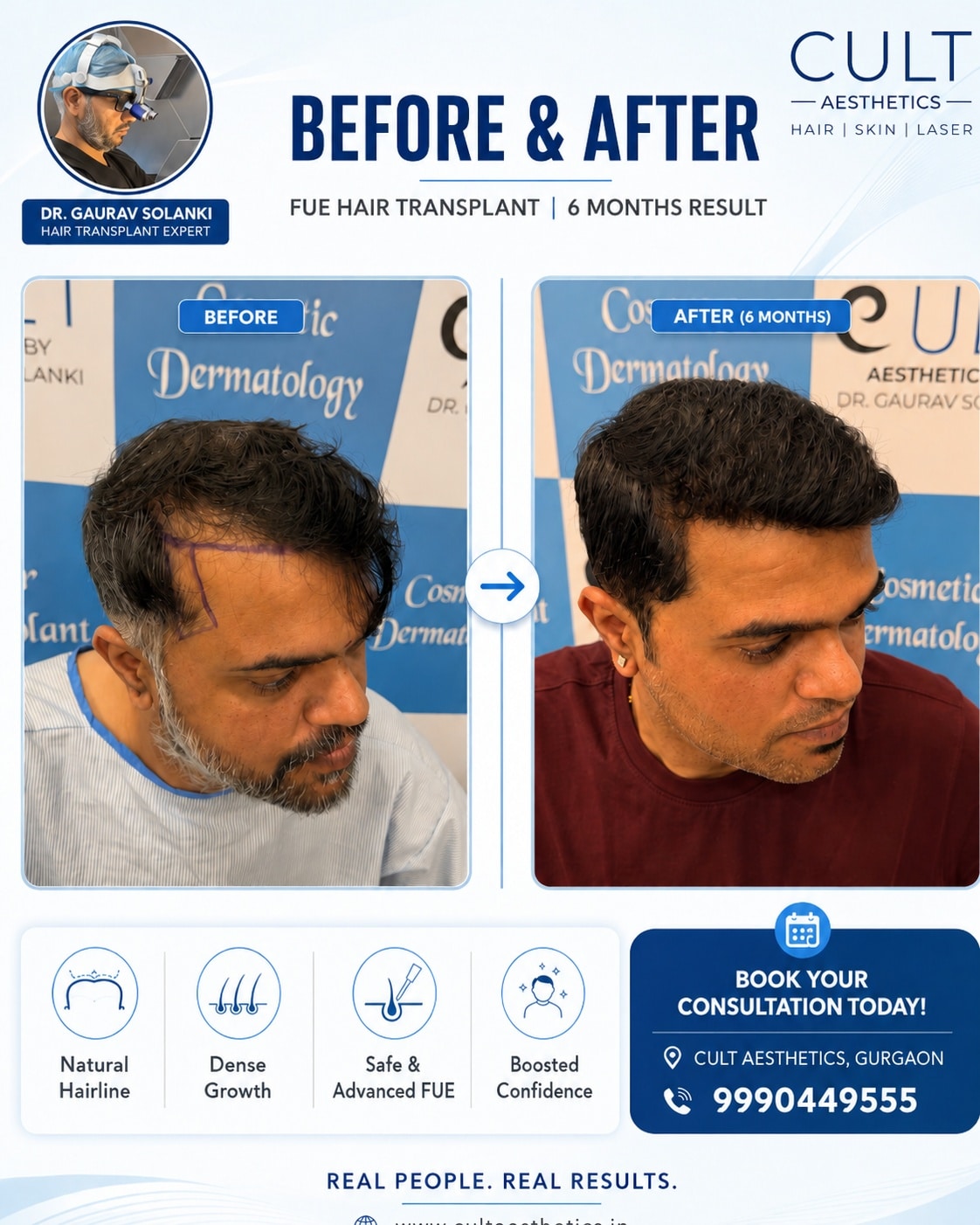
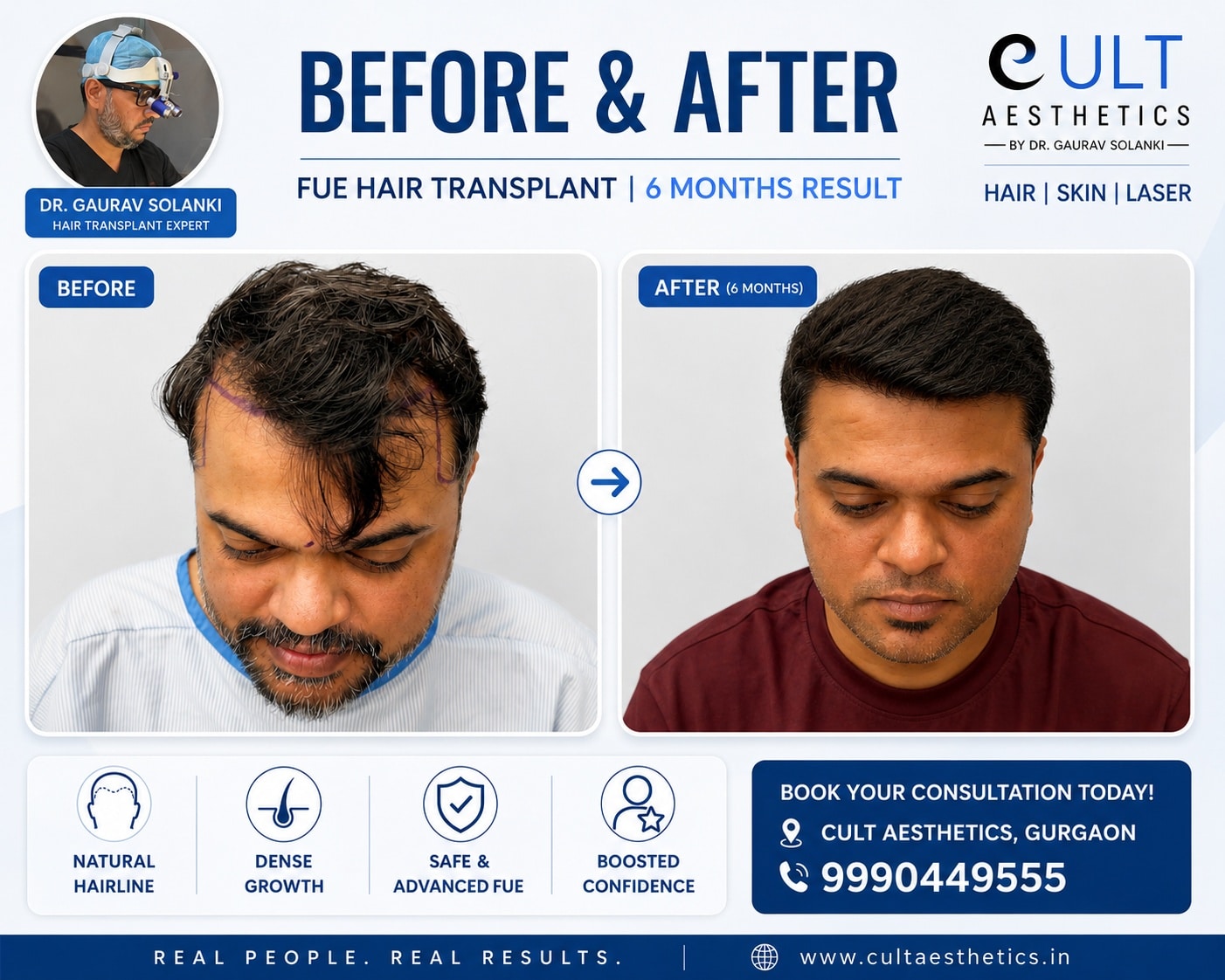
Swipe left to see more cases. Individual results vary; consultation is required to assess your specific case.
What does recovery actually look like, week by week?
- Day 1–3: Mild tightness, scabbing on the recipient area. Sleep elevated. Most patients work from home.
- Day 4–7: First post-op wash at the clinic. Scabs begin to lift. Discreet cap allowed outside.
- Day 14: Donor area healed to pinpoint marks. Recipient looks “shaved-style.” Office attendance possible without explanation in most cases.
- Week 4–8: “Shock loss” implanted hairs shed. This is expected. The follicle stays alive in the scalp.
- Month 3–4: First new growth begins. Fine, vellus hairs at first.
- Month 6: Substantial density visible. Most patients stop self-consciously checking.
- Month 12: Full maturation. Texture and pigmentation match surrounding hair. This is when before/after comparison is fair.
Why patients in Gurgaon and Delhi NCR choose Cult Aesthetics for DHI
Three structural differences from franchise DHI clinics in the region:
- One surgeon, every case. Dr. Gaurav Solanki MDS in Oral & Maxillofacial Surgery, 12+ years operating. Cult Aesthetics confirms 800+ documented hair transplant cases. Dr. Gaurav Solanki personally performs graft extraction, designs and marks the hairline, and makes recipient-site slits using a sapphire blade; technicians perform forceps-based no-touch implantation. Most “DHI clinics” rotate technician teams during the procedure. The patient never knows who actually placed which graft.
- Transparent, per-graft pricing. Our cost table above is what you will pay. We do not run “consultation surprises” where the quoted ₹60,000 becomes ₹1,40,000 after the donor is shaved.
- Surgeon-on-WhatsApp access for 30 days post-op. Direct line to Dr. Solanki for any concern itching, swelling, shedding worry, photo review. Not a coordinator queue.
Who should not have DHI?
DHI is not the right answer for everyone. Honest contraindications we screen for in consultation:
- Active alopecia areata or untreated thyroid-driven hair loss treat the medical condition first.
- Norwood 6–7 with poor donor density (under 60 follicles/cm²) the math doesn’t work; expectations cannot be met.
- Patients under 24 with unstable, fast-progressing hair loss finish the medical workup first.
- Unmanaged blood pressure, uncontrolled diabetes, or active scalp infection surgical safety threshold.
- Unrealistic expectations of teenage hairline density at age 45 better addressed by counselling than scalpel.
If any of these apply, the consultation will end with a medical plan instead of a surgery date. That’s the right outcome.
What DHI patients say on Google
4.8★ on Google. Three recent verified reviews below.
I spent a long time researching before choosing this clinic, and my experience so far has been very positive. Dr. Gaurav Solanki and the team at Cult Aesthetics provided clear communication and genuine care throughout the entire process.
View on Google →I was nervous before my hair transplant, but Dr Gaurav Solanki and the team made me feel comfortable throughout the journey. The procedure was painless, recovery was smooth, and the results are outstanding.
View on Google →Best hair transplant in Gurgaon. My experience is wonderful with Dr Gaurav satisfactory result. Thank you Cult Aesthetics team. Highly recommend.
View on Google →Book your DHI consultation with Dr. Gaurav Solanki
45-minute scalp analysis, honest graft estimate, written cost no pressure to commit.
Talk on WhatsApp · +91 99904 49555Frequently Asked Questions
Is sapphire blade hair transplant the same as DHI?
No. Sapphire blade is an FUE variant sapphire-tipped blades are used to create recipient channels before graft placement. Standard DHI uses an implanter pen that makes the channel and places the graft at once; at Cult Aesthetics, Dr. Solanki makes each site and grafts are placed with our no-touch forceps technique. They can be combined in a hybrid approach for cases that benefit from it.
Is DHI suitable for everyone?
No. DHI works best for hairline-focused cases, beard and eyebrow restoration, and patients who cannot shave the recipient area for work or social reasons. For very large sessions (3,500+ grafts), classical FUE is often faster and equally effective at lower cost.
Will the result look natural?
Natural results depend on three things: hairline design, angle and direction planning, and graft survival. The instrument itself does not make a hairline look natural; the surgeon does. Ask to see same-surgeon case galleries with 12-month photos at the consultation.
How long does DHI recovery take?
Initial healing: 7–10 days. Shock loss between weeks 4–8. First new growth at month 3–4. Full maturation at 10–12 months. Plan your social calendar around month 4, not month 1.
How many grafts will I need?
Graft requirements depend on the area treated, donor density, and the density target you want in the recipient zone. Norwood 3 patients typically need 1,500–2,000 grafts; Norwood 5 patients typically need 3,000–4,000. The actual number is set during the in-person consultation after trichoscopy.
Can PRP or GFC be combined with DHI?
Yes. PRP/GFC injections during and after the procedure can support graft survival and accelerate early growth. We discuss combination protocols when they add value not as upsell.
What is the right age for a hair transplant?
Age alone is not the criterion. Stability of hair loss is. We prefer to operate when the pattern has stabilised usually by the late 20s with medical management. Operating too early on a still-progressing pattern produces unnatural transition zones as the surrounding native hair continues to recede.
How do I know whether DHI, FUE, or non-surgical treatment is right for me?
A 45-minute scalp analysis with trichoscopy gives a clear answer. If your case is borderline, we will say so and recommend medical management first. Surgery is one option among several not the default.
Is DHI more painful than FUE?
No. Both procedures are performed under local anaesthesia. The only sensation is the initial anaesthetic injection. Post-op discomfort is typically mild and managed with paracetamol for 2–3 days.
What happens if a graft fails?
Some graft loss is normal how many grafts survive depends on handling time, hydration and technique. We track survival at 12 months. If a result needs touch-up, we offer a discounted revision session. Dr. Solanki personally reviews every 12-month case.
How Dr. Gaurav Solanki approaches DHI at Cult Aesthetics
Dr. Solanki’s surgical background is in Oral & Maxillofacial Surgery a discipline that depends on millimetre-precise tissue handling around the most visually exposed part of the body. Applied to hair restoration, that training shows up in three places: hairline aesthetics that match the patient’s facial proportions, donor extraction that preserves the long-term harvest, and graft handling that minimises out-of-body time.
He is a member of the International Society of Hair Restoration Surgery (ISHRS). He personally leads every procedure at Cult Aesthetics, Sector 46 Gurgaon there is no rotating technician model.
For related procedures and what often gets combined with DHI:
- FUE Hair Transplant in Gurgaon the other primary technique, often the right call for larger sessions
- Hair Transplant Cost in Gurgaon 2026 full pricing breakdown across techniques
- GFC Hair Treatment non-surgical adjunct that supports density
- PRP Hair Treatment useful for boosting graft survival post-op
What Our Patients Say
Rated 4.8★ from Google reviews
“I was nervous before my hair transplant, but Dr Gaurav Solanki and the team made me feel comfortable throughout the journey. The procedure was painless, recovery was smooth and the results are outstanding.”
Divyansh Sharma · Google
“As a doctor I evaluated clinics across Delhi NCR for three months before choosing Dr. Gaurav Solanki for my Grade-5 case. At 10 months the result is completely natural colleagues assume it is my own hair. The predictability of the outcome is what I value most.”
Medical Officer, Almora · Google
“Best hair transplant in Gurgaon. My experience is wonderful with Dr Gaurav, satisfactory result. Highly recommend the Cult Aesthetics team.”
Sagar Yadav · Google
What DHI Hair Transplant Patients Say
Verified Google reviews from Cult Aesthetics patients on the DHI procedure and recovery. Cult Aesthetics holds a 4.8★ rating across its Google reviews.
If your case is a repair rather than a first procedure, see our documented corrective hair transplant cases for botched and failed results.
“I was nervous before my hair transplant, but Dr Gaurav Solanki and the team made me feel comfortable throughout the journey. The procedure was painless, recovery was smooth and the results are outstanding.”
★★★★★ — Divyansh Sharma, verified Google review
“I am a 5 year old patient of Dr Gaurav for hair, when he was in South Delhi. I am very happy with my hairfall management. Got amazing results from GFC and PRP. Today I am getting my hair transplant as Dr told I will need for frontal hair.”
★★★★★ — Tushar Ji, verified Google review
“Brilliant results for my hair transplant with Dr Gaurav Solanki at Cult Aesthetics Gurgaon. Very good clinic for hair transplant and hair fall management. Very cooperative staff.”
★★★★★ — Sanoj Gaur, verified Google review
Read our reviews on Google Maps →
Hair Restoration Resources
Surgeon-authored guides on every aspect of hair transplant decision-making in Gurgaon and Delhi.
- ➜ Hair Transplant in Gurgaon
- ➜ Hair Transplant Cost in Gurgaon 2026
- ➜ FUE vs DHI vs Sapphire — Surgeon's Guide
- ➜ PRP vs GFC vs Mesotherapy
- ➜ How to Choose a Hair Transplant Surgeon
- ➜ Hair Transplant Cost in India 2026
- ➜ FUE Hair Transplant Gurgaon
- ➜ DHI Hair Transplant Gurgaon
- ➜ GFC Hair Treatment Gurgaon
- ➜ PRP Hair Treatment Gurgaon
- ➜ Hair Fall Treatment Gurgaon
- ➜ Best Hair Transplant Clinic in Delhi
- ➜ Beard Transplant Gurgaon
- ➜ Hair Transplant in Delhi