
PRP, GFC, and Mesotherapy are the three most common injectable treatments for hair loss in India. PRP works best for early-to-moderate genetic thinning. GFC, a refined next-generation version of PRP, delivers 5–10× more growth factors and shows results in fewer sessions, making it the stronger pick for moderate thinning. Mesotherapy is the right starting point when hair loss is driven by nutritional deficiency or stress, not genetics.
That’s the short answer. If you want to understand why these three treatments give different results and which one fits your specific stage of hair loss, budget, and biology the rest of this guide walks through the clinical evidence, the real cost of each in Gurgaon, the contraindications most clinic pages skip, and the point at which regenerative therapy stops being enough.
This guide is written by the medical team at Cult Aesthetics, Sector 46, Gurugram. Dr. Gaurav Solanki, MDS Oral and Maxillofacial Surgeon, Co-Founder, has 12+ years in hair restoration and supervises every PRP, GFC, and Mesotherapy protocol at the clinic.
What’s the actual difference between PRP, GFC, and Mesotherapy?
All three are injectable, non-surgical treatments that go into the same layer of the scalp. What differs is what’s in the syringe and that single difference changes everything about how each one works, how fast you see results, and which type of hair loss it actually fixes.
PRP (Platelet-Rich Plasma) the original autologous protocol
PRP uses your own blood. We draw about 20–30 ml from your arm, spin it in a centrifuge to separate the plasma rich in platelets, and inject that concentrated plasma into the thinning areas of your scalp. The platelets release growth factors PDGF, VEGF, EGF, IGF-1 that signal dormant hair follicles to re-enter the active growth phase and improve blood supply around the root.
It’s the most established of the three. A 2025 systematic review in Skin Health and Disease (Oxford Academic) of 12 randomised trials found PRP produced significant hair density improvement in South Asian androgenetic alopecia patients, with patient satisfaction rates between 91–100% across studies.
GFC (Growth Factor Concentrate) the refined evolution of PRP
GFC starts from the same blood draw, but the lab process is different. Instead of injecting whole platelets, the platelets are activated and the growth factors are extracted and concentrated then injected. No red blood cells, no white blood cells, no inflammatory debris. Just the active ingredient.
The practical effect: GFC delivers 5–10× the growth factor concentration of standard PRP, with less post-procedure pain and swelling. Clinical trials have shown a 50% increase in hair density with GFC versus 35% with PRP over a comparable course.
Mesotherapy nutrient delivery, not stem-cell signalling
Mesotherapy doesn’t use your blood at all. It uses a custom-formulated cocktail of vitamins (B-complex, biotin), minerals (zinc, selenium, copper), amino acids, peptides, and plant-based DHT blockers like saw palmetto. Some formulations include minoxidil. The cocktail is injected directly into the mesoderm the middle layer of the scalp where hair follicles are rooted bypassing the digestive system entirely.
Think of it as IV-grade nutrition delivered straight to the follicle. It works best when hair loss is being driven by something a multivitamin should fix but isn’t iron deficiency, post-pregnancy depletion, chronic stress, crash dieting.
How do PRP, GFC, and Mesotherapy compare side-by-side?
This is the decision table. Every factor here matters for choosing between the three.
| Factor | PRP | GFC | Mesotherapy |
|---|---|---|---|
| What’s injected | Your own platelet-rich plasma | Pure, concentrated growth factors from your blood | Vitamins, minerals, amino acids, DHT blockers |
| Blood draw needed | Yes (20–30 ml) | Yes (smaller volume) | No |
| Growth factor potency | 1× (baseline) | 5–10× PRP | N/A different mechanism |
| Sessions for initial course | 4–6, spaced 4 weeks apart | 3–4, spaced 4 weeks apart | 6–8, spaced 2 weeks apart |
| First visible result | Reduced shedding by week 4–6; density at 3–6 months | Reduced shedding by week 3–4; density at 3–4 months | Shedding reduction within 2–4 weeks |
| Pain / downtime | Mild soreness for 24 hours | Minimal most comfortable of the three | Very low |
| Maintenance after course | Every 4–6 months | Every 4–6 months | Every 4–8 weeks |
| Best suited for | Early-to-moderate genetic thinning | Moderate genetic thinning; post-transplant support | Deficiency-driven loss, telogen effluvium, post-pregnancy shedding |
One thing this table doesn’t show: none of these treatments regrow hair where the follicle is already dead. If the bald patch has been smooth and shiny for years, no injectable will bring it back. That’s a hair transplant conversation. We come back to that in the escalation section below.
Which one should you choose for your stage of hair loss?
The single biggest mistake we see at Cult Aesthetics is patients picking a treatment based on price or popularity instead of what their scalp actually needs. So here’s the decision framework we use in consultation.
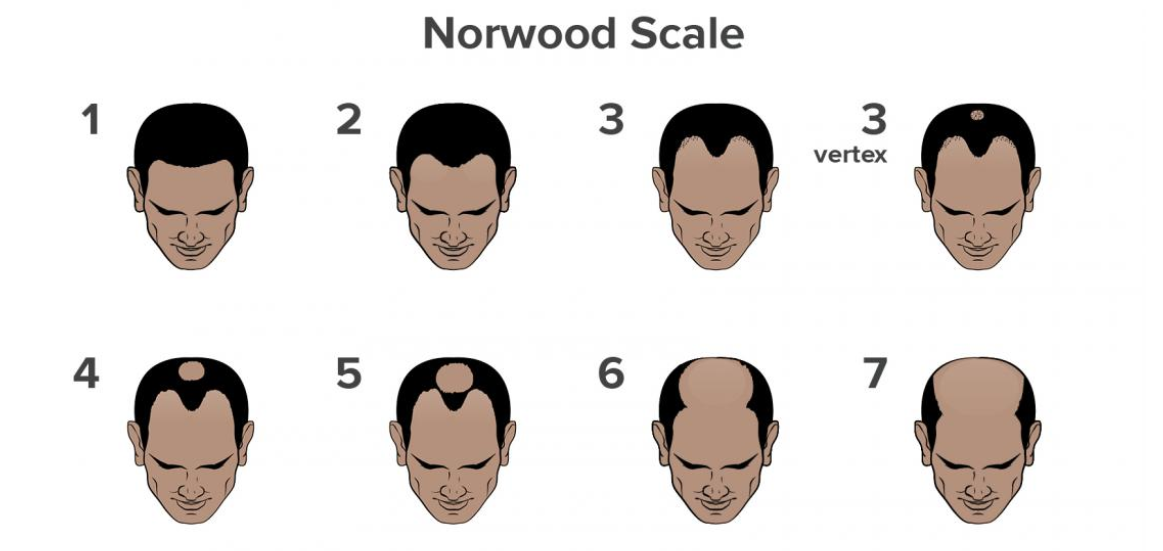
If your hair loss is in the early stages (Norwood 1–2 / Ludwig 1)
You’re seeing a slightly receding temple, a wider parting, more strands in the shower but the scalp looks normal otherwise. PRP is usually the right first move. It’s cost-effective, well-established, and at this stage your follicles are still very much alive and responsive. If blood tests reveal a deficiency (iron, B12, vitamin D), we’d pair it with a short Mesotherapy course.
If you’re in moderate thinning (Norwood 3–4 / Ludwig 2)
The crown is visible under bright light, the hairline has retreated meaningfully, density is dropping in measurable ways. GFC is the stronger clinical choice here. Faster results, fewer sessions, more potent stimulation. PRP can work, but you’re often paying for two extra sessions to reach a similar density outcome.
If your loss is sudden, diffuse, or post-event (telogen effluvium, post-COVID, post-pregnancy, post-crash-diet)
Your hair is shedding everywhere, not just one zone. Your blood panel probably shows something off. Mesotherapy is the first protocol. Fix the underlying deficiency, calm the follicle, and shedding typically drops within 4–6 weeks. PRP or GFC can come later if there’s an underlying genetic component too.
If you’re recovering from a hair transplant
GFC is the gold standard for protecting graft survival and accelerating density in the recipient zone. Most transplant patients at Cult Aesthetics get a GFC session at the 3-month and 6-month marks.
If you’re a woman with diffuse thinning
Female pattern loss almost never benefits from a single-treatment approach. A typical Cult Aesthetics protocol layers Mesotherapy (to correct nutritional/hormonal deficits common after pregnancy or with PCOS) followed by GFC for density.
How much do PRP, GFC, and Mesotherapy cost in Gurgaon?
Cost is the question most clinic pages dodge. Here are the real ranges in the Gurgaon / NCR market in 2026, based on what reputable surgeon-led clinics charge. Cult Aesthetics’ own pricing sits within these ranges exact cost depends on your hair loss grade and the number of sessions your scalp actually needs.
| Treatment | Per session (Gurgaon) | Initial course (full) | Annual maintenance (year 2 onward) |
|---|---|---|---|
| PRP | ₹7,000 – ₹12,000 | ₹28,000 – ₹72,000 (4–6 sessions) | ₹14,000 – ₹36,000 (2–3 sessions) |
| GFC | ₹10,000 – ₹15,000 | ₹30,000 – ₹60,000 (3–4 sessions) | ₹20,000 – ₹45,000 (2–3 sessions) |
| Mesotherapy | ₹3,500 – ₹6,000 | ₹21,000 – ₹48,000 (6–8 sessions) | ₹21,000 – ₹72,000 (6–12 sessions) |
Pricing shown reflects researched Gurgaon market ranges for 2026. Final cost depends on your consultation, hair loss grade, scalp assessment, and number of sessions required. Cult Aesthetics provides a written cost estimate after trichoscopy.
The 2-year total cost picture nobody shows you
Per-session cost is misleading. What matters is what you pay over 24 months initial course plus one year of maintenance. By that math, PRP and GFC end up roughly comparable for moderate hair loss, because GFC needs fewer maintenance visits. Mesotherapy looks cheap per session but is the most expensive over 24 months because of the frequency required to sustain results.
Cult Aesthetics offers EMI-style monthly plans for full PRP and GFC courses. Ask in consultation if cost over time is your main constraint.
Are these treatments safe? Who shouldn’t get them?
All three have established safety records when administered by a qualified dermatologist or hair surgeon using sterile, CDSCO-approved equipment. The risk profile isn’t zero, though and there are specific patients who shouldn’t get any of these treatments without medical clearance.
You should not get PRP or GFC if you:
- Are on anticoagulant medication (warfarin, heparin, apixaban, etc.) the platelet pathway is the entire mechanism
- Have a known platelet disorder, blood cancer, or chronic uncontrolled autoimmune condition
- Have an active scalp infection, folliculitis, or open wound in the treatment area
- Are pregnant or breastfeeding (insufficient safety data, not absolute risk)
You should not get Mesotherapy if you:
- Have a known allergy to any ingredient in the formulation (review the cocktail composition with your doctor first)
- Have active scalp eczema, psoriasis, or fungal infection treat the underlying skin condition first
- Are pregnant or breastfeeding
At Cult Aesthetics, every patient gets a basic blood panel and detailed medical history review before the first session. We’ve turned patients away from injectables more than once when the underlying cause was thyroid, ferritin deficiency, or alopecia areata that needed dermatological treatment first, not a regenerative shortcut.
What does the clinical evidence actually say?
A lot of clinic blogs make confident efficacy claims with no source. Here’s what the peer-reviewed literature actually shows in 2026.
The most cited recent study is Stefanis et al. (2024) in Skin Appendage Disorders a retrospective analysis of 72 androgenetic alopecia patients over 6 months. Both PRP and Mesotherapy with growth factors produced statistically significant improvements in hair density, hair thickness, and hair count on trichoscopy. PRP showed stronger frontal hair count improvement; Mesotherapy showed stronger vertex density improvement. Read the abstract on PubMed.
A 2020 systematic review on PMC analysed 12 PRP trials in androgenetic alopecia: 84% reported positive treatment outcomes, with 50% showing statistically significant improvement on objective density measures. View the review.
A 2025 systematic review in Skin Health and Disease (Oxford Academic) of 12 randomised PRP trials in South Asian patients reported significant density improvement with 91–100% patient satisfaction. Read the full paper.
GFC, being newer, has fewer head-to-head RCTs published, but the clinical signal is consistent across single-arm studies: faster onset, fewer sessions, less inflammation than PRP.
“The literature is clear that all three treatments work for the right patient. What it doesn’t capture is how often we see patients who’ve spent 80,000 rupees on the wrong protocol because nobody did a proper trichoscopy first. Diagnosis decides treatment not the other way around.”
Dr. Gaurav Solanki, MDS Oral and Maxillofacial Surgeon
When regenerative isn’t enough: the line to a hair transplant
This is the conversation honest clinics have and dishonest ones avoid. PRP, GFC, and Mesotherapy can slow, halt, and partially reverse hair loss but only when there’s still a viable follicle to work with. Once miniaturisation has progressed to terminal follicle death, no injectable will bring hair back.
The clinical signals that you’ve crossed that line:
- A bald zone that’s been smooth and shiny for more than 2–3 years
- No vellus (fine “peach fuzz”) hair visible under good light or trichoscopy
- Norwood grade 5 or above in men; Ludwig grade 3 in women
- You’ve completed a full PRP or GFC course (4–6 sessions) with no measurable density change at 6 months
At that point, the right conversation is FUE hair transplantation. Cult Aesthetics uses our proprietary SapphireArtisan™ FUE technique 100% surgeon-led, no technician-only procedures, designed for natural-looking hairlines.
What we’d never recommend: starting PRP or GFC on a Norwood 6 patient and charging them for six sessions that physically cannot work. If you’ve been quoted that, get a second opinion.
How Dr. Gaurav Solanki approaches PRP, GFC, and Mesotherapy at Cult Aesthetics
Every consultation at Cult Aesthetics starts with trichoscopy a magnified scan of your scalp that shows follicle miniaturisation grade in real time. We pair that with a basic blood panel (ferritin, vitamin D, B12, TSH at minimum). Only after both are reviewed do we recommend a protocol.
For most male patients with early genetic loss, that protocol is a 4-session PRP course with 6-monthly maintenance. For moderate loss or anyone who’s already tried PRP elsewhere without enough density gain, it’s GFC. For women, post-pregnancy patients, and anyone with a clear deficiency picture, it’s Mesotherapy first often combined with GFC after the deficiency corrects.
Dr. Solanki personally supervises every injection protocol. The clinic is in Sector 46, Gurugram, and runs by appointment. You can message Dr. Solanki directly on WhatsApp at +91 99904 49555 to ask whether PRP, GFC, or Mesotherapy is the right starting point for your specific scalp usually a 5-minute conversation.
Frequently asked questions
Is GFC really better than PRP, or is it just newer?
GFC isn’t universally better it’s better for specific cases. For moderate-to-advanced thinning, GFC’s higher growth factor concentration produces measurable density improvements faster and in fewer sessions. For early-stage thinning where follicles are still robust, PRP can deliver comparable results at a lower per-session cost. The right pick depends on your hair loss grade, not the marketing.
How long do PRP, GFC, and Mesotherapy results last?
None of these are permanent. PRP and GFC results typically last 4–6 months between maintenance sessions. Mesotherapy needs more frequent maintenance every 4–8 weeks. If you stop maintenance entirely, the underlying cause of hair loss (genetic, hormonal, nutritional) reasserts itself, and density usually declines over 6–12 months back toward baseline.
Can I combine PRP, GFC, and Mesotherapy in the same protocol?
Yes, and at Cult Aesthetics we often do. A common combination protocol for moderate hair loss with an underlying deficiency starts with Mesotherapy to correct nutritional status, then transitions to GFC for active density gain, followed by maintenance with either GFC every 6 months or low-frequency Mesotherapy. The hybrid approach almost always outperforms a single-treatment protocol for complex cases.
Will I need anaesthesia?
None of these require general anaesthesia. Most patients tolerate the injections with topical numbing cream applied 30 minutes before. PRP tends to feel slightly more uncomfortable than GFC or Mesotherapy because of the volume injected. A typical session takes 45–90 minutes start to finish; you walk out and resume your day.
Which works better for hair loss in women?
For female pattern hair loss, the right answer is rarely one treatment alone. Most women at Cult Aesthetics get a layered protocol Mesotherapy to address the nutritional and hormonal background (common after pregnancy, with PCOS, or post-thyroid issues), followed by GFC for active density restoration. PRP works but tends to be slower than the layered approach for diffuse female pattern thinning.
What about exosomes should I wait for that instead?
Exosome therapy is the newest regenerative option and the early data is promising, but it’s significantly more expensive (often 2–3× GFC pricing in India), and the long-term outcome data is still limited compared to PRP and GFC. For most patients in 2026, GFC offers the best balance of clinical evidence, cost, and result speed. If exosomes drop in price and accumulate more 5-year data, that calculus will shift.
How quickly will I see results, realistically?
Reduced shedding is the first visible change usually 3–6 weeks after starting any of the three. Visible density improvement on photo comparison takes 3–6 months for PRP and GFC, slightly longer for Mesotherapy unless the cause was a specific deficiency. Anyone promising “instant results from session 1” is overselling.
Ready to find out which one fits your scalp?
Hair loss treatment goes wrong when the protocol is picked without a proper diagnosis. The single most useful step you can take is a trichoscopy-based consultation 30 minutes, no commitment, and you walk out knowing exactly which of these three treatments (or which combination) makes sense for your stage.
Talk to Dr. Solanki on WhatsApp +91 99904 49555 | Cult Aesthetics, Sector 46, Gurugram
About the Author
Dr. Gaurav Solanki, MDS Oral and Maxillofacial Surgeon Co-Founder, Cult Aesthetics, Sector 46, Gurugram. 12+ years of clinical practice in hair restoration, including PRP, GFC, Mesotherapy, and the proprietary SapphireArtisan™ FUE technique. Cult Aesthetics is 100% surgeon-led no technician-only procedures. Read full bio →
Related reading
- Complete guide to PRP hair treatment in Gurgaon
- GFC treatment: how the next-generation PRP actually works
- FUE hair transplant: when injectables aren’t enough
- Real cost of a hair transplant in Gurgaon (2026)
Related read: Curious about Exosome therapy as a premium-tier alternative? See PRP vs GFC vs Exosome: which 2026 treatment wins. For the full PRP-specific protocol and FAQs, see PRP hair treatment in Gurgaon.
What patients say about PRP and GFC at Cult Aesthetics
Verified Google reviews from patients who completed PRP and GFC treatment with Dr. Gaurav Solanki, Cult Aesthetics, Sector 46, Gurugram.
“Best clinic for hair fall management. I got my PRP/GFC for hair at Cult Aesthetics Gurgaon and I am very happy with the treatment, the staff, the doctors all are very good and know what they are doing. Must recommended. Do visit once to get the best possible experience in hair and hair fall management.”
“I am a fitness trainer and looks matter the most. I was losing my hair as I keep long hair casually consulted Dr Gaurav and took PRP / GFC sessions, and seriously my hair health has become very good. The entire team is very cooperative. Must visit for hair-related issues. Doctor is friendly and absolutely non-commercial.”
“Have got hair fall management with Cult Aesthetics and got really good results. I had done hair botox at a salon 7 months after that, rapidly lost hair. Took GFC / PRP sessions on recommendation of Dr Gaurav and got amazing results in 3 months only, and now I am taking maintenance sessions from the clinic.”
Hair Restoration Resources
Surgeon-authored guides on every aspect of hair transplant decision-making in Gurgaon and Delhi.
- ➜ Hair Transplant in Gurgaon
- ➜ Hair Transplant Cost in Gurgaon 2026
- ➜ FUE vs DHI vs Sapphire — Surgeon's Guide
- ➜ PRP vs GFC vs Mesotherapy
- ➜ How to Choose a Hair Transplant Surgeon
- ➜ Hair Transplant Cost in India 2026
- ➜ FUE Hair Transplant Gurgaon
- ➜ DHI Hair Transplant Gurgaon
- ➜ GFC Hair Treatment Gurgaon
- ➜ PRP Hair Treatment Gurgaon
- ➜ Hair Fall Treatment Gurgaon
- ➜ Best Hair Transplant Clinic in Delhi
- ➜ Beard Transplant Gurgaon
- ➜ Hair Transplant in Delhi