
Sapphire FUE hair transplant is a refinement of the FUE technique where the recipient slits the microscopic channels into which each follicle is placed are created with a sapphire-edged blade instead of conventional stainless steel. The sharper, thinner sapphire edge produces cleaner cuts, less surrounding tissue trauma, faster scab clearance, and a denser, more natural hairline. At Cult Aesthetics in Sector 46, Gurugram, every Sapphire FUE procedure is personally performed end-to-end by Dr. Gaurav Solanki, a hair transplant surgeon with 12+ years of focused experience and over 450 documented cases. Per-graft pricing is transparent at ₹38–45.
What Is Sapphire FUE Hair Transplant?
Sapphire FUE belongs to the Follicular Unit Extraction family the modern category of hair transplant techniques where individual follicular units are removed from a permanent donor zone (the back and sides of the scalp) and implanted into thinning or bald areas. The “Sapphire” qualifier refers specifically to one tool in the procedure: the blade used to create the recipient sites where each follicle will sit.
In standard FUE, recipient site slits are made with conventional stainless-steel blades, typically 1.4–1.6 mm wide. In Sapphire FUE, those slits are made with a precision blade ground from synthetic sapphire typically 1.1–1.3 mm wide, with a far smoother edge geometry. Everything else about the procedure the donor extraction, the storage of grafts, the implantation is functionally identical to standard FUE.
This distinction matters. Some clinics market Sapphire FUE as if it is an entirely new technique. It is not. It is a quality refinement to one step of FUE. The surgeon’s skill, the hairline design, and the donor management remain the dominant variables in the final outcome.
Why a Sapphire Blade Changes the Outcome
The sapphire blade gives the surgeon three measurable advantages over conventional steel:
- Tighter recipient sites. Slit width drops from ~1.5 mm to ~1.2 mm. Tighter sites mean grafts seat more snugly, with less micro-movement during the first 48 hours when the body is anchoring them in place.
- Less surrounding tissue trauma. The smoother edge profile cuts cleanly rather than tearing. Adjacent capillaries and native hair follicles are spared, which translates to faster scab clearance and less shock loss in the recipient zone.
- Higher implantable density. Because each slit is narrower, more slits fit per square centimetre useful when designing a dense frontal hairline.
None of these advantages eliminate the need for careful planning or surgical judgement. A Sapphire-blade slit at the wrong angle will still produce an unnatural hairline. The blade reduces the margin for error; it does not remove the need for skill.
The SapphireArtisan™ Protocol at Cult Aesthetics
The SapphireArtisan™ protocol is the specific sequence Dr. Gaurav follows on every Sapphire FUE case at Cult Aesthetics. It is built around six principles, each of which we can defend with documented patient outcomes:
- Trichoscopic donor mapping before any decision on technique. We measure follicle density per cm² at four donor zones and reject patients whose donor density is insufficient to deliver the result they want.
- Freehand hairline design, drawn on the scalp with the patient in both seated and standing positions, mirror-checked, and adjusted in real time. We refuse stencils.
- Single-hair grafts only at the leading 10 mm of the hairline. Multi-hair grafts at the front edge are the single biggest reason a transplant looks “pluggy” years later. This is a hard rule.
- Sapphire-blade recipient slits at 1.1–1.3 mm, sized to match the graft caliber. Slits are angled at 20° forward in the central frontal zone and at the natural cowlick angle at the temporal corners.
- Bio-chilled holding solution for harvested grafts. Follicles wait at 4–8°C during the implantation phase, which preserves cellular viability across a long sitting.
- Documented case numbering. Every procedure performed is logged with a sequential case number, pre-procedure photo set, and 12-month follow-up photographs. Our public archive lists 450+ numbered cases.
You can see how the protocol plays out across patients of different Norwood grades in our documented before-and-after archive.
Who Is a Candidate for Sapphire FUE?
Sapphire FUE works best for patients who fall into one of these profiles:
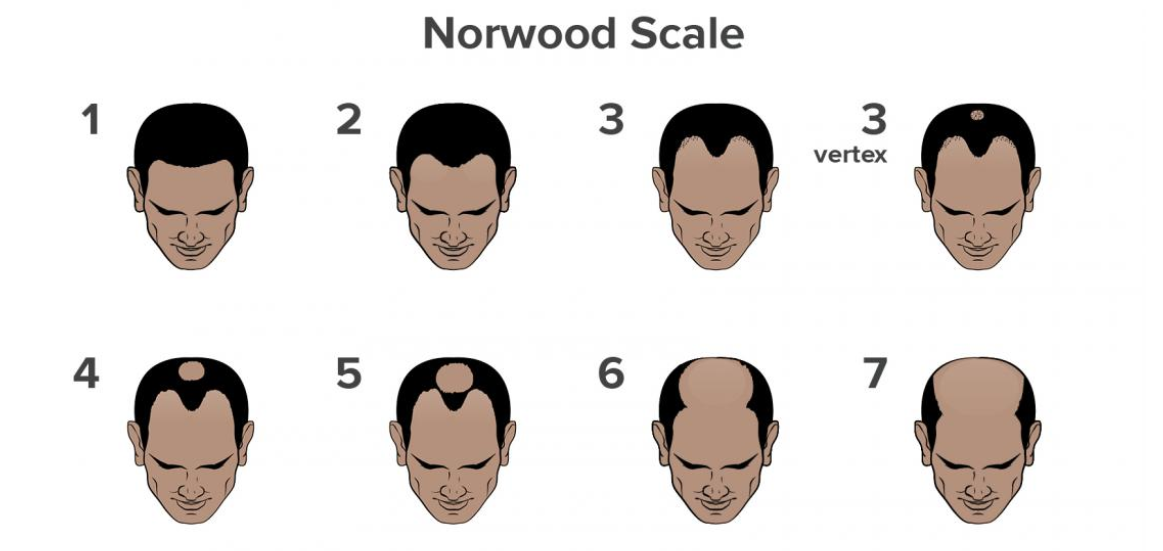
- Norwood Grade 2 through Grade 6 with stable donor density (above 70 follicles/cm² at the occipital zone).
- Patients who want maximum density in the hairline the frontal third of the scalp, where slit precision matters most.
- Patients with finer native hair, where the contrast between native and transplanted hair will be most obvious if angle and density are off.
- Patients seeking single-session high-density work where the surgeon needs to fit as many grafts as possible into the recipient area.
Sapphire FUE is not the right choice or any hair transplant is not the right choice for patients in any of these categories:
- Active alopecia areata or other scarring alopecias.
- Insufficient donor area less than 70 follicles/cm², or visible thinning at the occipital donor zone.
- Uncontrolled diabetes, bleeding disorders, or recent isotretinoin use.
- Unrealistic expectations around density, time-to-result, or longevity.
- Patients under 25 with an unstable Norwood pattern these cases need observation, not surgery.
If your case falls outside the safe envelope, we will say so during the consultation. We have referred patients to dermatology, endocrinology, and to non-surgical options like PRP or GFC when a transplant was the wrong answer.
Sapphire FUE vs Standard FUE vs DHI vs Bio-FUE Honest Comparison
Marketing material often presents these as four entirely different procedures. In reality, they are four variations on the same FUE base, distinguished mostly by the recipient-site instrument used. The honest comparison is below.
| Dimension | Standard FUE | Sapphire FUE | DHI (Choi pen) | Bio-FUE |
|---|---|---|---|---|
| Donor extraction | Motorised punch | Motorised punch | Motorised punch | Motorised punch |
| Recipient site creation | Steel blade slit | Sapphire blade slit | Choi pen (slit + implant in one step) | Sapphire blade slit + adjunct PRP/GFC |
| Typical slit width | 1.4–1.6 mm | 1.1–1.3 mm | 0.5–1.0 mm (pen tip) | 1.1–1.3 mm |
| Hairline density control | Good | Very good | Excellent for small zones | Very good |
| Recovery time | 7–10 days | 5–8 days | 5–8 days | 5–8 days |
| Per-graft cost at Cult | ₹35–40 | ₹38–45 | ₹40–45 | ₹40–48 |
| Best for | Most general cases | Density-focused hairlines | Crown work or very tight recipient zones | Patients seeking biostimulation alongside surgery |
The right choice depends on the patient donor characteristics, Norwood grade, area of focus, and budget. Dr. Gaurav will recommend a technique after the consultation; he will not insist that one technique is “the best” because no honest surgeon can. For a fuller comparison framework, see the dedicated FUE pillar and DHI pillar.
The Sapphire FUE Procedure Step by Step
A complete Sapphire FUE procedure at Cult Aesthetics runs about 6 hours for a typical 2,500-graft case. The same eight steps apply to every patient.
1. Consultation and hairline planning
Dr. Gaurav meets the patient, reviews medical history, evaluates donor density via trichoscopy, and designs the hairline freehand in both seated and standing positions. Photographs are taken in five standardised positions.
2. Pre-procedure preparation
The donor area is trimmed to about 1 mm. The patient changes into surgical attire; the scalp is cleaned with antiseptic. Vital signs are recorded.
3. Local anaesthesia
A ring block of the donor area is administered first, then the recipient field. The scalp is fully numb within ~10 minutes. There is no general anaesthesia and no IV sedation; the patient remains conscious and comfortable throughout.
4. Follicular extraction
Follicular units are extracted one by one from the donor zone using a 0.8 mm motorised punch. A typical 2,500-graft case takes 2–3 hours of extraction.
5. Graft preservation in bio-chilled holding solution
Extracted grafts are placed in a holding solution chilled to 4–8°C. This preserves follicle viability for the duration of the implantation phase.
6. Sapphire-blade recipient site creation
Dr. Gaurav creates each recipient slit individually with a sapphire blade at the planned angle, depth, and direction. Single-hair slits are placed at the leading edge; two- and three-hair slits are placed in the rows behind.
7. Graft implantation
Each graft is placed into its prepared slit using fine implantation forceps. Density is built gradually, working from the hairline backward.
8. Day-of discharge
The patient receives a take-home aftercare pack, written instructions, and a Day 1 review appointment. Most patients drive themselves home.
Recovery Timeline Week by Week
- Day 0: Mild discomfort, light dressings on the donor area, instructed not to drive for 4 hours after the procedure.
- Day 1: First review at the clinic. Dressings removed; donor area cleaned and re-inspected.
- Days 2–7: Scab phase. Tiny scabs form over each recipient slit. Gentle saline spray every 4 hours; no scrubbing or scratching.
- Day 7: Second review. Scabs clear with light washing; the recipient zone returns to its normal colour.
- Weeks 2–4: Shock loss begins. The transplanted hair shafts shed this is normal and expected. The follicles underneath are alive.
- Months 1–3: Quiet phase. The scalp looks much like it did before the procedure. No visible growth yet.
- Months 4–6: New growth becomes visible. Density at month 6 is roughly 60% of the final result.
- Months 9–12: Density consolidates; final hairline texture emerges; transplanted hair thickens and matures.
- Months 12–14: Final result. This is the comparison point we use for the 12-month before-and-after photographs.
Cost of Sapphire FUE in Gurgaon
Cult Aesthetics charges ₹38–45 per graft for Sapphire FUE transparent per-graft pricing with no hidden package fees. The total cost for a typical procedure ranges as follows:
- Norwood Grade 3 (1,800–2,400 grafts) ₹68,000 to ₹1,08,000
- Norwood Grade 4 (2,400–3,000 grafts) ₹91,000 to ₹1,35,000
- Norwood Grade 5 (3,000–3,500 grafts) ₹1,14,000 to ₹1,57,000
- Norwood Grade 6 (3,500–4,500 grafts, often staged) ₹1,33,000 to ₹2,02,000
The package includes the surgeon’s consultation, hairline design, the procedure itself, the take-home aftercare pack, the Day 1 and Day 7 reviews, and the Month 1, 3, 6, and 12 follow-ups. PRP add-ons are billed separately. EMI options are available through Bajaj Finserv and HDFC. For a full comparison across techniques and city averages, see our hair transplant cost guide for Gurgaon.
Sapphire FUE Patient Results 12-Month Gallery
Every Sapphire FUE case we perform is photographed at the same five standardised angles and reviewed at month 1, 3, 6, and 12. The full archive is in our public case studies browse the documented before-and-after gallery. The grade-specific galleries linked from our results page include front, top, side, and back views.
Risks and Realistic Expectations
Sapphire FUE is a low-risk outpatient procedure when performed correctly. That said, no surgical procedure is risk-free, and we tell every patient the same factual list of possibilities:
- Mild swelling of the forehead, usually peaking on day 3 and gone by day 7.
- Temporary numbness at the donor or recipient zones, usually resolving within 8–12 weeks.
- Tiny visible scabs at the recipient slits for 5–7 days.
- Shock loss in the transplanted hair and sometimes in surrounding native hair temporary and normal.
- Donor over-harvesting if planning is too aggressive. We prevent this by conservative graft budgeting.
- Sub-optimal density in patients with very thin native hair, despite the surgical technique being executed correctly.
- Rarely, the need for a second sitting to achieve the originally planned density.
We do not guarantee a specific number of strands per graft because no honest surgeon can. We do guarantee that every procedure is personally performed by Dr. Gaurav from start to finish, that the donor area will be conserved, and that our hairline design will look natural in side-lighting at 12 months.
Frequently Asked Questions Sapphire FUE in Gurgaon
What is Sapphire FUE hair transplant?
Sapphire FUE is a Follicular Unit Extraction hair transplant where the recipient slits are created with a sapphire-edged blade instead of conventional stainless steel. The sharper, thinner sapphire edge produces tighter, less-traumatic slits, which translates to faster healing and higher implantable density at the hairline.
How is Sapphire FUE different from standard FUE?
The difference is one step of the procedure: the recipient slits. In standard FUE these are made with a steel blade at 1.4–1.6 mm; in Sapphire FUE they are made with a sapphire blade at 1.1–1.3 mm. The donor extraction, graft preservation, and implantation steps are identical.
Does the sapphire blade improve graft survival rate?
Indirectly, yes. Tighter, cleaner slits seat the grafts more securely and cause less surrounding tissue inflammation, which supports graft survival in the first 72 hours. The bigger driver of survival, however, is graft handling and out-of-body time not the blade material.
How long is recovery after Sapphire FUE?
The scab phase lasts 5–8 days. Most patients return to indoor work in 3–4 days and to social settings in 10–14 days. The full cosmetic recovery when the recipient zone looks like a normal scalp is 14–21 days. Final results emerge at month 12–14.
Is Sapphire FUE more expensive than standard FUE?
Slightly. At Cult Aesthetics, Sapphire FUE is ₹38–45 per graft compared to ₹35–40 for standard FUE. For a 2,500-graft case, the difference is approximately ₹7,500–₹12,500.
What is the SapphireArtisan™ protocol?
SapphireArtisan™ is the specific procedural sequence Dr. Gaurav follows on every Sapphire FUE case at Cult Aesthetics. Its six principles are trichoscopic donor mapping, freehand hairline design, single-hair-only leading edge, sapphire-blade recipient slits, bio-chilled graft storage, and sequential case documentation.
Can Sapphire FUE be done on Norwood Grade 6?
Yes, often in two staged sittings nine to twelve months apart. The first sitting covers the hairline and frontal third; the second covers the crown. Patients with limited donor density may need adjunct PRP, finasteride, or a more conservative density target.
Is Sapphire FUE FDA approved?
The sapphire blade itself is a sterile single-use medical device and is regulated by the appropriate national authorities. There is no separate FDA approval for “Sapphire FUE” as a technique, just as there is no FDA approval for “FUE” or “DHI” as named techniques these are descriptions of how a surgeon uses instruments. Safety depends on surgeon training and clinic standards.
Why should I choose Sapphire FUE at Cult Aesthetics over other clinics?
Because every step of every procedure is personally performed by Dr. Gaurav Solanki, not by technicians. Because pricing is transparent and per-graft, with no hidden package surcharges. Because we have 450+ documented numbered cases with 12-month photographs. And because we will tell you honestly when a transplant is not the right answer for your specific case.
Book Your Sapphire FUE Consultation in Gurgaon
The first step is a free 30-minute consultation in person at our clinic in Sector 46, Gurugram, or online. Dr. Gaurav personally evaluates your donor density, discusses your hairline goals, recommends a technique (which may not be Sapphire FUE), and gives you a transparent cost estimate within 48 hours. There is no pressure to book.
To schedule, call or message us on WhatsApp, or fill out our consultation form. Patients travel to Cult Aesthetics from Delhi, Noida, Faridabad, Sohna Road, DLF, Golf Course Road, Greater Kailash, and Vasant Kunj and from across India and abroad. For NRI patients, see our dedicated NRI hair transplant page.
Reviewed by Dr. Gaurav Solanki, MBBS, MS ISHRS-affiliated hair transplant surgeon, Cult Aesthetics, Sector 46, Gurugram. Last reviewed: 24 May 2026.
This page describes general medical information and outcomes typical for patients treated at Cult Aesthetics, Gurugram. Individual results vary based on Norwood grade, donor density, age, lifestyle, and other clinical factors. The information provided does not constitute medical advice; please book a consultation for an evaluation tailored to your case.
What Our Patients Say
Rated 4.8★ from 542 Google reviews
“As a doctor I evaluated clinics across Delhi NCR for three months before choosing Dr. Gaurav Solanki for my Grade-5 case. At 10 months the result is completely natural colleagues assume it is my own hair. The predictability of the outcome is what I value most.”
Medical Officer, Almora · Google
“Best hair transplant in Gurgaon. My experience is wonderful with Dr Gaurav, satisfactory result. Highly recommend the Cult Aesthetics team.”
Sagar Yadav · Google
“I was nervous before my hair transplant, but Dr Gaurav Solanki and the team made me feel comfortable throughout the journey. The procedure was painless, recovery was smooth and the results are outstanding.”
Divyansh Sharma · Google
Hair Restoration Resources
Surgeon-authored guides on every aspect of hair transplant decision-making in Gurgaon and Delhi.
- ➜ Hair Transplant in Gurgaon
- ➜ Hair Transplant Cost in Gurgaon 2026
- ➜ FUE vs DHI vs Sapphire — Surgeon's Guide
- ➜ PRP vs GFC vs Mesotherapy
- ➜ How to Choose a Hair Transplant Surgeon
- ➜ Hair Transplant Cost in India 2026
- ➜ FUE Hair Transplant Gurgaon
- ➜ DHI Hair Transplant Gurgaon
- ➜ GFC Hair Treatment Gurgaon
- ➜ PRP Hair Treatment Gurgaon
- ➜ Hair Fall Treatment Gurgaon
- ➜ Best Hair Transplant Clinic in Delhi
- ➜ Beard Transplant Gurgaon
- ➜ Hair Transplant in Delhi