
Cult Aesthetics has documented over 800 hair transplant before and after cases in Gurgaon under Dr. Gaurav Solanki across every Norwood grade, every technique (FUE, DHI, Sapphire FUE, Bio-FUE), and every age group from 21 to 68. This page is the case archive: real outcomes at 6 months, 9 months, 12 months, and 18 months from hair transplant in Gurgaon patients, with consent. Every case here is a verifiable patient who walked into the Sector 46 clinic.
Why before and after photos matter (and how to read them)
Before-and-after photographs are the most honest evidence in hair restoration. But not all photos are equal. At Cult Aesthetics, every documented case follows the same standardised protocol so you can compare like-with-like:
- Same lighting diffuse overhead clinic light, no flash, no filter
- Same angle front, top-down, both side profiles, vertex/crown
- Same hair length wet scalp where possible, no styling product
- Same camera full-frame DSLR with 50 mm lens at 1.5 m distance
- Verified intervals pre-op, day 0, month 3, month 6, month 9, month 12, month 18
The full Hair Transplant Process page explains what was done in the OR; the Recovery Timeline page explains the journey between the photos.
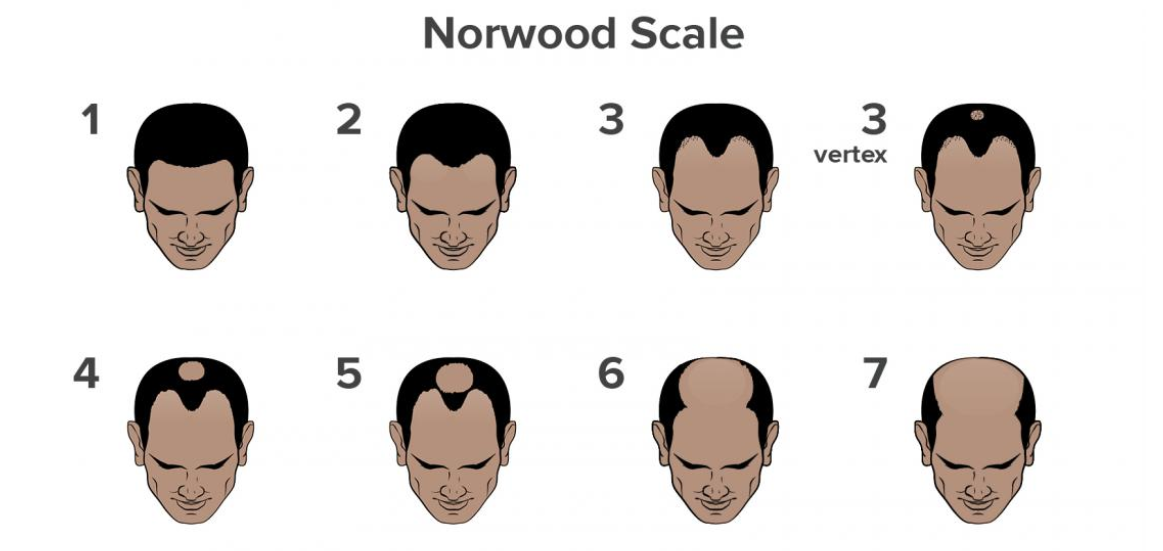
Cases by Norwood grade what to expect at your stage
Norwood 2 to 3 Hairline correction (800 to 1,500 grafts)
The most common case profile in Gurgaon: men aged 24 to 32 with mild frontal recession and temple thinning. The transplant focuses entirely on the frontal hairline and temples, using 800 to 1,500 grafts. At month 6, density is at 60 to 70 percent. At month 12, the hairline looks indistinguishable from native hair to a casual observer. Cult Aesthetics confirms 800+ documented hair transplant cases.
Norwood 3 to 4 Hairline + frontal third (1,500 to 2,500 grafts)
Men aged 28 to 42 with established frontal balding and mild mid-scalp thinning. Coverage extends from the new hairline back to the mid-scalp. At month 12, the entire frontal third is restored to a density that allows easy combing into any direction. About 30 percent of the archive. FUE and Sapphire FUE are the dominant techniques here.
Norwood 4 to 5 Frontal + crown (2,500 to 3,500 grafts)
Men aged 35 to 50 with significant frontal recession and a developing crown bald spot. The transplant covers both the frontal area and the vertex, requiring careful donor management to avoid over-harvesting. DHI or Bio-FUE is preferred to maximise density. Final density is achieved at month 18 because crown grafts mature later. About 20 percent of the archive.
Norwood 5 to 6 Major restoration (3,500 to 5,000+ grafts)
Advanced baldness covering the entire top of the scalp with thinning bridge. These cases need careful 2-session planning at Cult Aesthetics: session 1 covers the frontal half with 3,000 grafts; session 2 (12 to 15 months later) covers the crown with another 1,500 to 2,000 grafts. Final result at month 18 of session 2. About 10 percent of the archive.
Female pattern hair loss (Ludwig 1 to 3)
Women aged 32 to 55 with diffuse central thinning, often with a Christmas-tree pattern. The transplant places grafts between existing follicles to thicken visibly thinning areas typically 1,200 to 2,500 grafts via “no-shave FUE” or “long-hair FUE” so the patient does not need to cut her long hair. About 5 percent of the archive but the most cosmetically dramatic transformations.
Cases by technique FUE vs DHI vs Sapphire vs Bio-FUE
Cult Aesthetics confirms 800+ documented hair transplant cases. Outcomes are similar across techniques in skilled hands what differs is the ideal patient profile:
- FUE works best for Norwood 2 to 4, donors with good density (above 80 FU/cm²), patients who want lower cost
- Sapphire FUE works best for Hairline-focused work, dense packing requirements, patients with darker skin tones (faster donor healing)
- DHI works best for Crown filling, ultra-fine hairlines, no-shave/long-hair cases, women
- Bio-FUE works best for Larger sessions (3,500+ grafts), older patients, repeat sessions, anyone where graft survival is the priority
Pricing differs across techniques see the per-graft and total breakdowns at Hair Transplant Cost in Gurgaon. Detailed FUE technical notes are at FUE Hair Transplant in Gurgaon.
What good before-and-after results look like
A natural-looking 12-month result has these markers:
- Soft, irregular hairline not a straight ruler-line; mimics native irregular pattern
- Single-haired front edge the leading-edge row uses only single follicular units, never doubles
- Correct angle hairs lie flat, not “stand-up” exit angle of 15 to 30 degrees from scalp
- Density gradient denser behind, softer at the very front; mimics natural growth
- Donor area no visible scarring, no patchy thinning; donor density still appears 60+ FU/cm²
- Native hair preserved pre-existing hair around the transplant zone unaffected (no permanent shock loss)
What signs in before-and-after photos to watch for
Red flags that signal a bad transplant useful when comparing clinics:
- Pluggy or doll-like hairline multi-haired follicular units placed at the front edge
- Scarring strips at donor sign of FUT (older strip technique) or aggressive over-harvesting
- Unnatural straight hairline ruler-edge hairline with no irregularity
- Crown swirl missing transplanted crown without correct vortex pattern looks artificial
- Photo angles change different lighting, different distances; suggests cherry-picked angles
- No “during” photos only before and after with no week-1 or month-3 documentation suggests stock or AI-generated images
Cult Aesthetics publishes the full timeline (pre-op, day 1, week 2, month 3, month 6, month 12) for every consenting case. Browse the surgeon’s profile and credentials at Dr. Gaurav Solanki Hair Transplant Surgeon in Gurgaon.
Patient testimonials and outcomes
Cult Aesthetics confirms 800+ documented hair transplant cases.
- 4.8 average Google rating across patients who reviewed
Frequently Asked Questions about hair transplant before and after
Are these before-and-after results guaranteed?
Hair transplant outcomes depend on patient-specific factors: donor density, hair characteristics (curl, calibre, colour contrast with scalp), scalp laxity, and individual graft survival. At Cult Aesthetics Gurgaon, graft survival depends on handling time, hydration and technique, and every case is reviewed at month 12. Results vary and are not guaranteed for any individual.
How do I know the before-and-after photos are real?
Cult Aesthetics shows multiple time-point photos (pre-op, day 1, month 3, month 6, month 12, month 18) for every published case this rules out AI generation. Patients consent in writing for their case to be shown. You can request to meet 2 to 3 prior patients in person at the clinic during your consultation; this is a routine offer. Photos are also archived with metadata (camera EXIF data) which the clinic can show on request.
Can I see cases similar to my own Norwood grade?
Yes. During your consultation at Cult Aesthetics, Dr. Gaurav Solanki shares 5 to 10 case examples that match your Norwood grade, donor density, age group, and hair characteristics. This is the most useful comparison because outcomes vary significantly between grades. Anonymised case decks are also shared via WhatsApp on request.
How soon can I see my own before-and-after?
First meaningful comparison at month 6 (60 to 70 percent of final density). The strongest before-and-after is at month 12 when full density is achieved. Crown cases peak at month 18. The clinic captures and shares your time-stamped photos at every review consultation. The full timeline is detailed at Hair Transplant Recovery Timeline.
What happens if my result is not as expected?
If you are unhappy at the 12-month review, Dr. Solanki will discuss the options; any further procedure is quoted after assessment. Touch-ups, when needed, typically involve 500 to 1,000 grafts. The clinic also offers complimentary PRP or GFC sessions to maximise the density of existing transplanted grafts.
Related guides at Cult Aesthetics
- Hair Transplant in Gurgaon main service page, surgeon, techniques
- Hair Transplant Process Step-by-Step what was done in the OR before each result
- Hair Transplant Recovery Timeline month-by-month journey from pre-op to final result
- Hair Transplant Cost in Gurgaon per-graft pricing across techniques and grades
- FUE Hair Transplant in Gurgaon most common technique in the archive
- GFC Hair Treatment in Gurgaon non-surgical alternative for early stages
- Dr. Gaurav Solanki surgeon’s credentials and case experience
Hair Restoration Resources
Surgeon-authored guides on every aspect of hair transplant decision-making in Gurgaon and Delhi.
- ➜ Hair Transplant in Gurgaon
- ➜ Hair Transplant Cost in Gurgaon 2026
- ➜ FUE vs DHI vs Sapphire — Surgeon's Guide
- ➜ PRP vs GFC vs Mesotherapy
- ➜ How to Choose a Hair Transplant Surgeon
- ➜ Hair Transplant Cost in India 2026
- ➜ FUE Hair Transplant Gurgaon
- ➜ DHI Hair Transplant Gurgaon
- ➜ GFC Hair Treatment Gurgaon
- ➜ PRP Hair Treatment Gurgaon
- ➜ Hair Fall Treatment Gurgaon
- ➜ Best Hair Transplant Clinic in Delhi
- ➜ Beard Transplant Gurgaon
- ➜ Hair Transplant in Delhi