
The hair transplant process in Gurgaon is a same-day, walk-in surgical procedure performed under local anaesthesia. From consultation to final results, the full journey runs across 12 to 18 months but the actual surgery is over in 6 to 9 hours. This step-by-step guide walks you through every stage of the hair transplant in Gurgaon performed by Dr. Gaurav Solanki at Cult Aesthetics, with timing, what to expect, and what determines outcomes at each step.
Hair transplant process at a glance: 7 steps
- Consultation and trichoscopy 30 to 45 minutes
- Pre-op blood work and graft planning 1 to 2 days before surgery
- Donor area shaving and local anaesthesia first hour on surgery day
- Graft extraction (FUE, DHI, or Sapphire FUE) 3 to 4 hours
- Recipient site creation and hairline design 1 hour
- Implantation 2 to 3 hours
- Recovery and growth 7 days for healing, 12 to 18 months for full results
Step 1 Consultation and trichoscopy
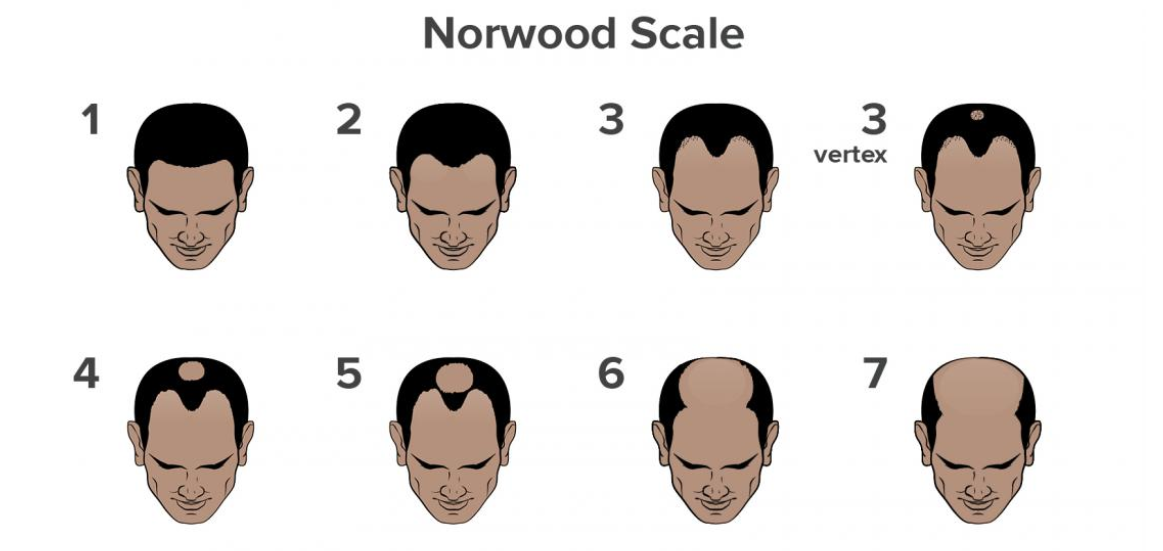
The hair transplant process starts with a 30 to 45 minute consultation at Cult Aesthetics in Sector 46 Gurgaon. Dr. Gaurav Solanki examines your scalp under a digital trichoscope, measures donor density (typically 70 to 100 follicular units per cm²), grades baldness on the Norwood-Hamilton scale (Norwood 1 to 7 for men, Ludwig 1 to 3 for women), and computes the graft count needed for the area you want covered.
This is also where the hairline is sketched in temporary marker, the technique is recommended (FUE, DHI, Sapphire FUE, or Bio-FUE see the FUE Hair Transplant in Gurgaon guide for the technical detail), and the all-inclusive quote is shared. If you are an early-stage candidate (Norwood 2 to 3) and not yet ready for surgery, the consultation may instead recommend GFC Hair Treatment in Gurgaon or PRP Hair Treatment in Gurgaon as a non-surgical alternative.
Step 2 Pre-op blood work and graft planning
One to two days before surgery, you complete a pre-op panel: complete blood count (CBC), random and fasting blood sugar, thyroid stimulating hormone (TSH), serum ferritin, and screening for hepatitis B, hepatitis C, and HIV. These tests confirm you are a safe surgical candidate and rule out underlying causes of hair loss that should be treated first (anemia, hypothyroidism, diabetes).
Two weeks before surgery, you stop minoxidil, aspirin, vitamin E, alcohol, and smoking. Finasteride continues only with the surgeon’s clearance. The graft plan is finalised: number of grafts, donor harvest pattern, hairline design, and crown coverage strategy. Cost depends on the final graft count see the full Hair Transplant Cost in Gurgaon breakdown for per-graft pricing across FUE, DHI, Sapphire FUE, and Bio-FUE.
Step 3 Donor area shaving and local anaesthesia
On surgery day, you arrive after a normal breakfast (no fasting required) and wear a button-down shirt. The donor area at the back and sides of the scalp is shaved to 1 mm length to expose follicular units for extraction. Some women and long-hair patients opt for an “unshaven FUE” or “long-hair FUE” where only a strip below the long hair is shaved the long hair covers it post-op.
Local anaesthesia (lignocaine + adrenaline + bupivacaine, ring-block technique) is then injected around the donor and recipient zones. This takes 15 to 20 minutes and the scalp is numb for the next 6 to 8 hours. There is no general anaesthesia and no overnight stay hair transplant in Gurgaon is a walk-in walk-out procedure.
Step 4 Graft extraction (the technique you choose)
This is the longest stage 3 to 4 hours for 2,000 to 3,500 grafts. The technique determines the punch size, healing pattern, and final density:
- FUE (Follicular Unit Extraction) 0.8 to 1.0 mm motorised punch, individual follicle extraction, healing dots invisible under 5 mm hair length within 7 days.
- Sapphire FUE same extraction as FUE but uses a sapphire blade for recipient sites; finer slits, faster epithelialisation, tighter graft packing.
- DHI (Direct Hair Implantation) extraction with FUE punch, then implantation through a Choi pen with no separate slit-creation step; allows higher density and shorter graft-air-exposure.
- Bio-FUE FUE extraction with bio-chilled graft storage at 4°C in HypoThermosol or ATP-rich solutions; 3 to 5 percent higher graft survival in long sessions.
Grafts are sorted by follicular unit type singles, doubles, triples, quadruples under a stereo microscope while extraction continues. Singles go to the hairline for natural softness; multi-haired units go to the mid-scalp and crown for density.
Step 5 Recipient site creation and hairline design
While extraction is underway, the recipient sites are created with sapphire blades or custom-made cut-to-clear (CTC) blades, sized to match the graft diameter (0.6 to 0.9 mm). Site angle, direction, and depth are set to mimic native hair flow this is the single most artistic step and the one that separates a natural-looking result from a “transplanted look”.
Hairline design follows the Marko-Vasilic frontotemporal point rule, the Norwood-friendly rounded mid-front, and individual face-shape assessment. Dr. Gaurav Solanki marks the hairline with the patient seated upright in front of a mirror never reclined to ensure the line falls correctly relative to the brow position when the patient stands and walks.
Step 6 Implantation and graft survival
Implantation places each graft into its prepared recipient site using either jeweller forceps (for stick-and-place) or Choi pens (for DHI). At Cult Aesthetics, grafts are kept in chilled HypoThermosol throughout the session graft-air-exposure is minimised below 4 hours per graft, the threshold above which survival drops below 90 percent.
Graft survival of 90 to 95 percent is achieved through a combination of: short out-of-body time, atraumatic extraction, correct depth of placement (epidermis level), no bending or crushing during placement, and a moist surgical field. Implanted grafts are dressed lightly with saline; the donor area is cleaned with antiseptic solution but not bandaged.
Step 7 Recovery and growth timeline
The procedure ends around 6 to 7 PM if started at 9 AM. You leave the clinic with printed post-op instructions, a mild painkiller, a 5-day antibiotic course, antihistamines for swelling, and a saline spray. The crucial first-week milestones are: scab fall-off by day 10, donor redness fading by day 7, and shock loss starting around week 3.
For the full day-by-day, week-by-week, month-by-month recovery pattern, see the Hair Transplant Recovery Timeline in Gurgaon guide. To see what 12-month results look like across Norwood grades, browse the Hair Transplant Before and After Gurgaon 800 Cases archive.
\nFor a broader review of possible postoperative effects and warning signs, see the hair-transplant side-effects guide.
\n\n\nHow long does the entire hair transplant process take in Gurgaon?
From the first consultation to final 12-month density, expect this timeline:
- Day -14 to Day 0 Consultation, blood work, medication washout
- Day 0 (surgery day) 6 to 9 hours including breaks
- Day 1 to Day 10 Initial healing, scab formation and shedding
- Day 14 to Day 90 Shock loss; transplanted hairs shed (this is normal follicles stay)
- Month 4 to Month 6 New growth begins, first visible thickening
- Month 6 to Month 9 60 to 70 percent of final density visible
- Month 12 Full result; hairline matures and softens
- Month 18 Crown grafts (last to mature) reach final density
Cost of each step what is included in the all-inclusive package
At Cult Aesthetics, the per-graft price covers the entire process there are no separate charges for individual steps. The base FUE rate is Rs 30 to 45 per graft, DHI is Rs 50 to 60, Sapphire FUE is Rs 60 to 75, and Bio-FUE is Rs 75 to 120. The all-inclusive package covers consultation, trichoscopy, pre-op blood tests, the procedure, post-op medication, complimentary PRP or GFC session at month 1, and 12 months of follow-up. See the full breakdown at Hair Transplant Cost in Gurgaon.
Frequently Asked Questions
How long does a hair transplant procedure take in Gurgaon?
The actual surgery takes 6 to 9 hours for 2,000 to 3,500 grafts, with two 15-minute breaks for lunch and stretching. Smaller cases (800 to 1,500 grafts for early hairline correction) finish in 4 to 5 hours. The full pre- to post-op journey from first consultation to final results spans 12 to 18 months.
Is hair transplant painful during the procedure?
The only pain is the local anaesthesia injection itself a 5 to 10 second sting at each injection site. After that, the scalp is fully numb for 6 to 8 hours. Patients typically watch movies, listen to podcasts, or nap during extraction and implantation. Most report the procedure as “boring rather than painful”. Mild scalp tenderness for 24 to 48 hours after the anaesthesia wears off is managed with paracetamol.
What is the difference between FUE and DHI in the procedure flow?
FUE separates extraction, slit creation, and implantation into three sequential phases. DHI uses a Choi pen that combines slit creation and graft placement into one motion, eliminating the slit-creation phase and shortening graft-out-of-body time. DHI typically allows 5 to 10 percent higher density per cm² but is slower per graft. Sapphire FUE is technically a slit-creation upgrade, not a separate technique it uses sapphire blades for finer recipient sites.
Can I drive home after a hair transplant?
Yes local anaesthesia does not affect driving capability and there is no sedation given. However, after sitting for 6 to 9 hours, most patients prefer to be picked up by family or take a cab. Cult Aesthetics in Sector 46 Gurgaon is 15 minutes from Cyber City and 25 minutes from IGI Airport for outstation patients.
What if I am not yet ready for hair transplant what does the process look like?
If trichoscopy shows you are still in early stages (Norwood 1 to 3) with active miniaturising follicles, surgery is not the right first step. The clinic will recommend a 6 to 12 month course of GFC or PRP combined with topical minoxidil and (where indicated) finasteride. This protocol is detailed at Hair Fall Treatment in Gurgaon. Surgery is reconsidered at month 12 when the response to medical therapy is clear.
Related guides at Cult Aesthetics
- Hair Transplant in Gurgaon main service page with techniques, surgeon, 800+ case index
- Hair Transplant Recovery Timeline day-by-day what to expect post-op
- Hair Transplant Before & After Gurgaon 800 Cases visual case archive
- Hair Transplant Cost in Gurgaon transparent 2026 pricing per technique and graft count
- FUE Hair Transplant in Gurgaon sapphire blades, bio-FUE, technique deep-dive
- GFC Hair Treatment in Gurgaon non-surgical option for early-stage hair loss
- PRP Hair Treatment in Gurgaon combination therapy partner
- Dr. Gaurav Solanki surgeon profile, credentials, and case experience
Hair Restoration Resources
Surgeon-authored guides on every aspect of hair transplant decision-making in Gurgaon and Delhi.
- ➜ Hair Transplant in Gurgaon
- ➜ Hair Transplant Cost in Gurgaon 2026
- ➜ FUE vs DHI vs Sapphire — Surgeon's Guide
- ➜ PRP vs GFC vs Mesotherapy
- ➜ How to Choose a Hair Transplant Surgeon
- ➜ Hair Transplant Cost in India 2026
- ➜ FUE Hair Transplant Gurgaon
- ➜ DHI Hair Transplant Gurgaon
- ➜ GFC Hair Treatment Gurgaon
- ➜ PRP Hair Treatment Gurgaon
- ➜ Hair Fall Treatment Gurgaon
- ➜ Best Hair Transplant Clinic in Delhi
- ➜ Beard Transplant Gurgaon
- ➜ Hair Transplant in Delhi