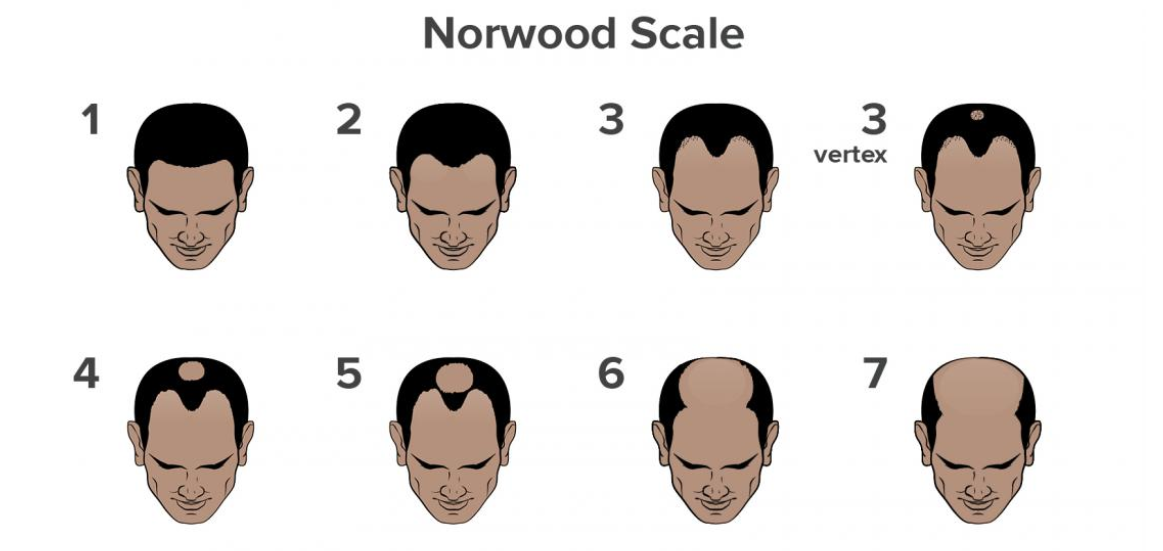

Crown hair transplants are technically the most demanding area of hair restoration — and the most commonly botched. At Cult Aesthetics, Sector 46 Gurgaon, Dr. Gaurav Solanki rebuilds the crown’s natural whorl pattern graft by graft, and is equally clear about when crown surgery should wait or be skipped in favour of medical treatment.
Why the Crown Is Different From Every Other Area
The crown, or vertex, is not a flat patch of scalp — it is a spiral. Hair at the crown radiates outward from a central whorl, changing direction through a full 360 degrees within a few centimetres. Recreating this swirl requires the surgeon to alter the angle and direction of every incision continuously as the pattern turns. Transplant the crown like a hairline, with uniform direction, and the result looks combed-over and unmistakably surgical. This is why crown work exposes the difference between technician-driven clinics and surgeon-performed procedures faster than any other zone.
The Crown Is a Graft Eater: Budgeting Realistically
A bald crown looks deceptively small in the mirror but commonly spans 50 to 100 square centimetres — and because the spiral exposes scalp between hairs, it needs respectable density to read as covered. A moderate crown typically consumes 1,500 to 2,500 grafts; an advanced one can swallow 3,000 or more. Dr. Solanki measures the area, checks your donor reserve and tells you plainly whether your crown can be covered well, partially, or whether donor hair is better invested at the front. That conversation happens before surgery, not after.
Should You Transplant the Crown at All?
Not always. The crown is usually the last zone to bald and the first to keep expanding, so operating on an actively widening vertex in a young patient risks a transplanted island ringed by progressing loss. In younger men, the smarter sequence is often medical stabilisation — finasteride, minoxidil, regenerative support — with crown surgery deferred until the pattern settles. In older patients with stable loss and a healthy donor, direct crown transplantation works beautifully. The decision rests on age, progression and donor math, not on enthusiasm.
Procedure, Recovery and the Slow Crown Timeline
Crown transplants at Cult Aesthetics use FUE under local anaesthesia, with the whorl mapped and marked before a single graft is placed. Recovery mirrors any FUE session — crusts for a week, shedding through weeks two to six — but expect patience on regrowth: the crown is notoriously the slowest zone to mature. Where the front shows change by month four or five, the crown often needs twelve to eighteen months for its full result. Knowing this in advance prevents the mid-journey panic many crown patients feel.
Documented Crown Results
We document crown cases with top-down photography under consistent lighting, from pre-op markings through every growth milestone. See the linked crown results article below for complete case walk-throughs, including graft counts and timelines, so you can judge the work on evidence.
Related Resources
- Crown Baldness Results Explained
- Tackling the Bald Spot on the Crown
- How Many Grafts Do I Need?
- Hair Transplant in Gurgaon
- Online Consultation
Frequently Asked Questions
How many grafts does a crown hair transplant need?
A moderate crown typically needs 1,500 to 2,500 grafts; advanced vertex baldness may need 3,000 or more. The area is measured in square centimetres before quoting.
Why does crown hair transplant growth take so long?
The crown has comparatively lower blood supply and a complex spiral pattern. Full maturation routinely takes 12 to 18 months, slower than the frontal zone.
Can a crown transplant look natural?
Yes, when the surgeon recreates the natural whorl by varying graft angle and direction through the spiral. Uniform placement is what creates fake-looking crowns.
Should I transplant my crown if I am in my twenties?
Often not yet. An actively expanding crown in a young patient is usually stabilised medically first, with surgery deferred until progression slows.
Can the crown and front be transplanted together?
Yes, if donor supply and session limits allow. When grafts are limited, the frontal zone is generally prioritised for its greater visual impact.
Wondering if your crown is ready for surgery? Book an online consultation with Dr. Gaurav Solanki at Cult Aesthetics, Sector 46 Gurgaon, or call +91-9990449555. Every case is assessed personally by the surgeon — no counsellors, no sales pressure.
Hair Restoration Resources
Surgeon-authored guides on every aspect of hair transplant decision-making in Gurgaon and Delhi.
- ➜ Hair Transplant in Gurgaon
- ➜ Hair Transplant Cost in Gurgaon 2026
- ➜ FUE vs DHI vs Sapphire — Surgeon's Guide
- ➜ PRP vs GFC vs Mesotherapy
- ➜ How to Choose a Hair Transplant Surgeon
- ➜ Hair Transplant Cost in India 2026
- ➜ FUE Hair Transplant Gurgaon
- ➜ DHI Hair Transplant Gurgaon
- ➜ GFC Hair Treatment Gurgaon
- ➜ PRP Hair Treatment Gurgaon
- ➜ Hair Fall Treatment Gurgaon
- ➜ Best Hair Transplant Clinic in Delhi
- ➜ Beard Transplant Gurgaon
- ➜ Hair Transplant in Delhi