
A hair transplant repair fixes the visible damage from a previous failed procedure unnatural hairlines, low density, pluggy front rows, exposed donor scars, or grafts placed at the wrong angle. At Cult Aesthetics in Gurugram, Dr. Gaurav Solanki performs around eight to ten repair cases every month, most of them on patients who first had surgery in Turkey, smaller Indian cities, or technician-led “factory” clinics. This guide walks you through what’s salvageable, what isn’t, and what it costs.
If you only have two minutes: wait twelve months after your original surgery before judging the result. If the hairline is still pluggy, low-density, or the scar shows, repair is possible in most cases but is more technically demanding than a fresh transplant. Repair pricing at Cult Aesthetics runs ₹75–₹115 per graft, compared to ₹60–₹90 for a primary FUE case. The single most important decision is choosing a surgeon who does repair routinely, not occasionally.
How do you know your hair transplant has failed?
Most patients who walk in for a repair consult describe one of five problems. None of them needs a microscope to spot.
- An unnatural, blunt hairline. Straight-line edges. No irregular zig-zag. Multi-hair grafts in the front row instead of single follicles. The result reads “transplant” from across a room.
- Pluggy front grafts. Visible round bumps where three or four hairs share a single recipient slot. Common in old FUT work and aggressive Turkish megasessions where the surgeon prioritised graft count over angle.
- Low or patchy density. The hair grew, but the result looks transparent under direct light. Usually means too few grafts were placed, or graft survival was poor due to dehydration, rough handling, or out-of-body time over six hours.
- A visible FUT scar. A pink or white linear scar across the back of the head, sometimes 3 to 6 millimetres wide, that shows when hair is buzzed or styled short.
- A depleted donor zone. Bald or thinned-out patches at the back where the surgeon over-harvested in pursuit of graft count. The most difficult problem to fix.
If one or more of these matches your case at the twelve-month mark, you have a real result to work with not a recovery phase still in progress.
The timeline for spotting failure
- Day 1–14: Pink scabs, normal swelling. You can’t judge anything yet.
- Week 3–8: Shock loss. Transplanted hair sheds. This is expected and not failure.
- Month 3–6: New growth starts. Density looks thin because the hair is still short and fine.
- Month 9: Eighty per cent of the final result should be visible. Hairline shape is now fixed.
- Month 12: Final result. If density, angle, or hairline shape is wrong now, it will not change without intervention.
Why do hair transplants fail in the first place?
Failures cluster around three causes, and they’re not what most patients assume.
1. Technician-led surgery. In many high-volume Turkey clinics and discount Indian setups, the surgeon meets the patient for the consult and the marking, then leaves the room. Junior technicians do the extraction and implantation. The result is fast and cheap, but the angle, depth, and density decisions get made by someone who isn’t medically qualified to make them.
2. Wrong technique for the case. FUT is still the right call for a Norwood 5 with a strong donor strip and a low aesthetic priority on a scar-free nape. FUE is right for most others. Picking the technique by what the clinic does most, rather than what the patient needs, sets up bad outcomes from the start.
3. Donor mismanagement. Punching grafts from outside the safe donor zone (the strip between the occipital protuberance and the upper neck) means harvesting hair that will continue to thin with age. Five years on, the donor zone looks moth-eaten and the front result thins along with it. Aggressive megasessions of 4,500+ grafts in a single sitting from a marginal donor are the most common cause.
Lifestyle and aftercare cause some failures too smoking within the first 30 days, alcohol within the first week, uncontrolled diabetes, scalp infections from poor hygiene. But those reduce graft survival. They don’t produce a pluggy hairline. That’s a surgical-decision problem.
“Most failures we repair aren’t biology. They’re cost-cutting. The patient saved fifty thousand rupees and now needs another two and a half lakh to undo the damage. The maths almost never works out.”
Dr. Gaurav Solanki, Cult Aesthetics
When should you wait, and when should you act?
The default answer is wait at least twelve months from your original surgery. Sometimes longer. Here’s why:
- Shock loss is normal. Existing hair around the recipient zone sheds for the first three to four months and grows back. Repairing during this window means working with a confusing mix of new and recovering hair.
- Graft maturity takes time. The hair you can see at month six is not what you’ll see at month twelve. Some grafts come in late.
- Scalp scarring needs to mature. Recipient and donor scars firm up by month nine to twelve. Operating into immature scar tissue increases the risk of poor graft uptake the second time too.
The exceptions: if you have a clear infection, ongoing necrosis, or a visibly catastrophic hairline placement that’s causing severe psychological distress, intervention at month six is reasonable. Cosmetic camouflage with SMP can happen earlier than surgical repair we’ll come back to that.
What does a repair hair transplant actually involve?
Repair is rarely just “do another transplant on top.” It’s usually a combination of three techniques used together, customised to what’s wrong with your case.
1. Graft excision and re-implantation. The badly placed grafts wrong angle, plug-style, on a low hairline are punched out one by one with a 0.8 to 1 millimetre punch. The follicles are kept alive in chilled storage. Then they’re re-implanted at the correct angle, in single-follicle units, into new slits. This is the most technically intense part of repair surgery and the slowest. A single session might handle 1,500 to 2,000 redirected grafts.
2. Camouflage with new grafts. Where the existing density is too low to fix by redirection alone, fresh single-follicle grafts are added in front and between existing ones to build a natural irregular edge. The new grafts come from the original scalp donor if it’s still viable, or from beard or chest donor (body hair transplant) if not.
3. Scar revision. For visible FUT linear scars or wide-punched FUE scars, two options: FUE into the scar (placing fresh follicles directly into mature scar tissue, which works at 60–70% normal density), or scalp micropigmentation tattooing to camouflage the linear mark. Many cases use both.
The order matters. We typically excise plugs and unwanted angles first, let those punch sites heal for three to six months, then come back for the camouflage and density-fill in a second session. Doing everything in one go works in straightforward cases but increases the risk of patchy growth in complex ones.
How is a repair transplant different from a primary one?
If you’ve had a primary FUE done well, the second surgery isn’t twice as hard it’s three to four times as hard, in clinical terms. Here’s the contrast:
| Factor | Primary hair transplant | Repair hair transplant |
|---|---|---|
| Surgical complexity | Standard | 3–4× higher needs precise graft excision plus redesign |
| Time per session | 6–8 hours | 8–10 hours, often split into two sessions |
| Donor availability | Full safe-zone available | Often depleted; may need beard or chest donor |
| Graft survival rate | Depends on handling time, hydration and technique | Lower in repair and scar tissue; reviewed at 12 months |
| Aesthetic ceiling | Can reach pre-loss density | Realistic, age-appropriate density only |
| Pricing at Cult Aesthetics | ₹60–₹90 per graft | ₹75–₹115 per graft |
| Recovery time | 10–14 days for social recovery | 14–21 days; punch-site healing adds a week |
The aesthetic ceiling is the part most patients don’t want to hear. If your first surgeon over-harvested the donor or placed grafts at a hairline that was too low to start with, repair will give you a far better result than what you have but it won’t give you the head of hair you would’ve had if the first procedure was done right. Donor follicles you’ve already lost don’t come back.
Can a Turkey hair transplant failure be fixed in India?
Yes, and this is now a significant share of repair cases nationally. Cult Aesthetics sees patients monthly who flew to Istanbul for a four-figure-euro mega-package, came home, waited twelve to fifteen months, and realised the result they were sold isn’t the result they got.
The pattern is consistent: 4,000+ grafts harvested in a single 6-hour session by technicians, hairline placed two centimetres too low, density at the temples and crown left for a “second free session” that the patient never returns for, and a depleted donor zone the patient only notices when they buzz their hair short.
Repair in India works for these cases because:
- Senior-surgeon-led model is standard at top Indian clinics. Dr. Gaurav Solanki plans every repair case, designs every hairline and makes every recipient incision himself; his trained team assists with extraction and implantation under his supervision.
- Pricing is one-fifth of what a UK or US repair would cost. A 2,500-graft repair at Cult is ₹1,87,500 to ₹2,87,500 (roughly USD 2,230–3,420 at ₹84/USD), versus £15,000–£25,000 in London or USD 18,000–30,000 in New York.
- The Indian medical tourism infrastructure works. Consult by WhatsApp, fly in, three-day stay, fly home. Post-op video reviews monthly.
The honest caveat: if your Turkey clinic over-harvested the donor to the point of permanent thinning, no amount of repair will fully restore what you would’ve had. Manage expectations early.
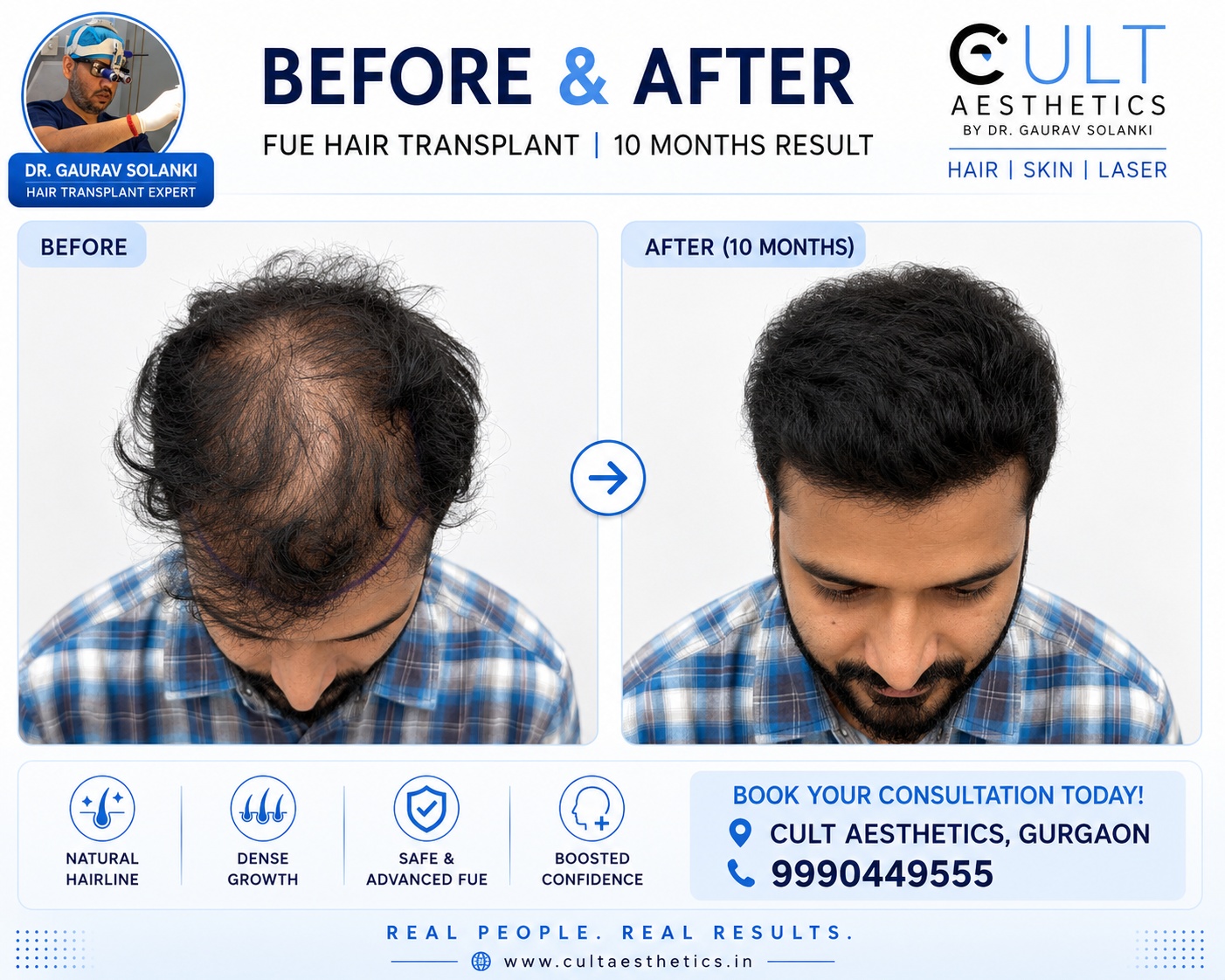

“I came to Cult Aesthetics from Bareilly 280 km away after a failed hair transplant at a local clinic. The previous hairline was unnatural, grafts were patchy, hairs grew in the wrong direction, and the donor area was over-harvested. Dr. Gaurav personally did a trichoscopy, explained exactly what had gone wrong, and gave a realistic corrective plan without any false promises. He performed the entire revision surgery himself hairline redesign, fixing wrong-angle grafts, density improvement.
The result is so natural that people who didn’t know before still don’t realise I had a transplant. The confidence I had lost after the failed hair transplant has come back.”
What does repair hair transplant cost in India?
Repair pricing at Cult Aesthetics in Gurugram works on the same per-graft basis as primary surgery, at ₹75–115 per graft, about a 25% premium over primary FUE reflecting the additional surgical time:
- Hairline-only repair (800–1,200 grafts redirected): ₹60,000 – ₹1,38,000
- Density-fill repair (1,500–2,500 grafts new + redirected): ₹1,12,500 – ₹2,87,500
- Major reconstruction with body hair (3,000+ grafts, two sessions, beard donor): ₹2,25,000 – ₹5,75,000 total
- Scar revision with SMP only (no surgical grafts): ₹40,000 – ₹70,000
The total cost depends on three things: how many grafts need to be excised and redirected, how many fresh grafts the case needs added, and whether the donor zone is healthy enough to supply them all from the scalp. Patients with severe donor depletion sometimes need body hair transplant, which adds extraction time and graft count.
EMI options available (terms confirmed at consultation). International patients pay the same INR pricing the medical tourism premium some clinics add for foreigners doesn’t apply at Cult.
When repair won’t work and what your options are then
This is the section other repair clinics skip, and it’s the most important one. Some cases shouldn’t have surgery at all. Knowing which yours is saves you another year of disappointment.
Case 1 Donor depleted past the safe zone. If the original clinic harvested deep into the upper neck or temple-side zones, those follicles are non-permanent and will thin over time. Adding more surgery here speeds up the donor collapse. Right call: stop. Consider scalp micropigmentation only it creates a buzz-cut illusion across the whole scalp without needing donor.
Case 2 Aggressive autoimmune cause. Patients with undiagnosed alopecia areata, lichen planopilaris, or other scarring alopecias sometimes had their original transplant fail because the underlying disease attacked the new grafts too. Surgery on top will fail the same way. Right call: medical management first, dermatologist referral, biopsy if needed. Repair conversation can resume only after the disease is stable for 18 months.
Case 3 Norwood 6 or 7 with realistic Norwood 2 expectations. If you came in expecting your hairline to look like it did at age 22, repair won’t get you there because donor supply is the limit. Right call: a frank conversation about realistic age-appropriate density. Most patients adjust expectations and come back for surgery; some decide a hairpiece, SMP-only, or accepting the current state is the better choice for them.
Case 4 Less than 12 months post-surgery. If you haven’t reached month 12 yet, your “failed result” might still be in progress. Right call: wait. Document the result with photos every four weeks. Reassess at month 12 with the photos in hand.
None of these means you’ve run out of options. SMP works alone or in combination. Hairpieces are increasingly sophisticated and chosen by some patients who could surgically qualify for repair but prefer the flexibility. The wrong answer is to push surgery on a case that won’t benefit.
How Dr Gaurav Solanki approaches repair hair transplant at Cult Aesthetics
Repair work is now roughly 22% of the surgical volume at Cult Aesthetics. The protocol Dr. Solanki uses for every repair consult:
- Photo audit first. Patient submits hairline, crown, donor and side views before the in-person consult. About one in five cases gets advised to wait, not operate.
- In-person scalp assessment. Donor density measured at three sites (occipital, temporal, retroauricular). Recipient density assessed. Scar mapping if applicable. Hairline redesign sketched on the scalp with the patient holding a mirror.
- Two-session plan by default. Session one: excision and redirection of bad grafts. Six-month wait. Session two: density-fill and final hairline shaping. Single-session repair is offered only for hairline-only cases.
- SapphireArtisan™ FUE for the new grafts. Sapphire-blade slits give finer channels, denser packing, and faster recipient healing especially important when working around existing transplanted hair.
- Monthly video follow-ups for twelve months. Photos at month 3, 6, 9 and 12. Final assessment at month 12 with comparison side-by-side against the original failed state.
Dr. Gaurav Solanki is an Oral and Maxillofacial Surgeon (MDS, Oral & Maxillofacial Surgery) and Co-Founder of Cult Aesthetics. He has 12+ years of clinical practice and 800+ documented cases, specialising in FUE hair transplant, hairline design, corrective hair transplant, and non-surgical hair fall management.
FAQs
Can a failed hair transplant be fully reversed?
It can be substantially corrected, but not fully reversed in every case. The realistic goal is a result that looks natural, age-appropriate, and undetectable in normal social settings not a return to the head of hair you had before any procedure. Cases with intact donor and only hairline-design problems repair almost completely. Cases with depleted donors face a real ceiling.
How long after a failed hair transplant should I wait before repair?
Minimum twelve months from the original surgery. This lets shock loss resolve, transplanted grafts mature fully, and the scalp scarring stabilise. Operating earlier into immature tissue increases the chance the repair fails too. The only exceptions are clear infections or severe psychological distress requiring earlier camouflage with SMP.
Will I have visible scarring from a repair hair transplant?
Repair surgery uses FUE punches of 0.8 to 1 millimetre, which heal as pinpoint marks that fade within four to six weeks and are invisible at conversational distance. Older FUT scars from the original surgery don’t disappear, but can be camouflaged with FUE-into-scar or scalp micropigmentation, often combined.
How much does it cost to fix a Turkey hair transplant in India?
A typical Turkey-failure repair at Cult Aesthetics ranges approx. ₹1,87,500 to ₹3,80,000 depending on graft count and whether body hair transplant is needed. International patients pay the same INR pricing. The total trip cost including flights and stay is still roughly 70% less than equivalent repair in the UK or US.
Can I do repair surgery and SMP at the same time?
SMP is done after repair surgery, typically four to six months after the final transplant session, once new grafts have matured and stabilised. Doing SMP first changes the visual landscape and makes graft placement harder. The sequence matters.
Will the donor area heal back after repair surgery?
The donor zone heals over six to eight weeks. New extraction creates fresh pinpoint scars that aren’t visibly different from the original FUE marks. If the donor was already over-harvested in the first surgery, no clinical technique will fully restore donor density the lost follicles don’t grow back.
Is repair surgery covered by health insurance in India?
No. All hair transplant surgery, including repair, is classified as cosmetic and excluded from Indian health insurance policies, both private and public.
Should I report or sue the clinic where my original transplant failed?
That’s a legal question outside the scope of clinical care. Practically: keep before-and-after photos, surgery records, consent forms and receipts. A consumer-forum complaint is the most common Indian remedy and works occasionally for major outliers. For most patients, the energy is better spent on the repair pathway than the original-clinic dispute.
Talk to Dr Solanki about your case
Most repair consults at Cult Aesthetics start with a free WhatsApp photo review three photos (hairline, donor, crown) and a brief description of your original surgery. Dr. Solanki personally reviews these within 48 hours and tells you whether repair is realistic, what it would involve, and what it would cost. No commitment to surgery either way.
Talk to Dr Solanki on WhatsApp →
About the Author

Dr. Gaurav Solanki, MDS Oral and Maxillofacial Surgeon Hair Transplant Surgeon & Co-Founder, Cult Aesthetics, Sector 46, Gurugram. 12+ years in surgical hair restoration, 800+ documented cases, and a particular focus on repair and corrective transplant work. Read full bio →
Watch: Failed Hair Transplant Repaired — Crown Corrected & Hairline Restored
Watch: Corrective Hair Transplant — 2nd Sitting vs Repair
Related Corrective Transplant Resources
- Can a Bad Hair Transplant Be Fixed?
- Why Do Hair Transplants Fail?
- Top 5 Reasons Hair Transplant Failures Occur
- Corrective Hair Transplant — Real Case Study
- Hairline Correction in Gurgaon
- Before & After Results
- Book an Online Consultation
Hair Restoration Resources
Surgeon-authored guides on every aspect of hair transplant decision-making in Gurgaon and Delhi.
- ➜ Hair Transplant in Gurgaon
- ➜ Hair Transplant Cost in Gurgaon 2026
- ➜ FUE vs DHI vs Sapphire — Surgeon's Guide
- ➜ PRP vs GFC vs Mesotherapy
- ➜ How to Choose a Hair Transplant Surgeon
- ➜ Hair Transplant Cost in India 2026
- ➜ FUE Hair Transplant Gurgaon
- ➜ DHI Hair Transplant Gurgaon
- ➜ GFC Hair Treatment Gurgaon
- ➜ PRP Hair Treatment Gurgaon
- ➜ Hair Fall Treatment Gurgaon
- ➜ Best Hair Transplant Clinic in Delhi
- ➜ Beard Transplant Gurgaon
- ➜ Hair Transplant in Delhi