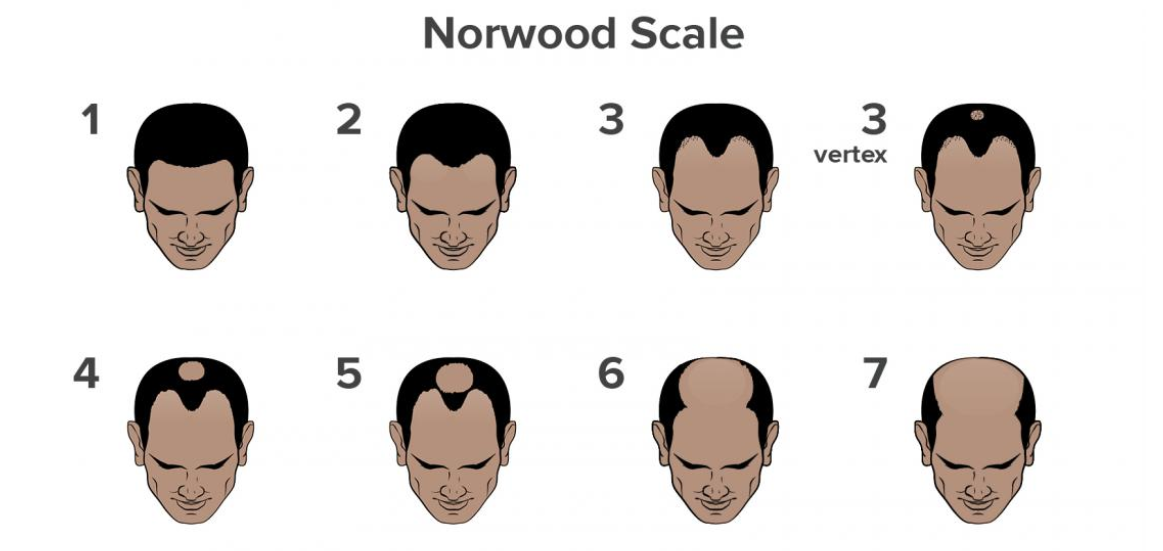

For grade 1 and grade 2 hair loss, the honest answer is usually treatment first, transplant later — if at all. At Cult Aesthetics in Sector 46 Gurgaon, Dr. Gaurav Solanki frequently advises early-stage patients against surgery they do not yet need, and builds a medical plan to stabilise loss before any blade or punch comes near the scalp.
What Grade 1 and 2 Hair Loss Look Like
Grade 1 is essentially a mature hairline — minimal or no recession, often just a softening of the juvenile hairline that nearly all men experience. Grade 2 shows early triangular recession at the temples, giving the first hint of an M-shape. Neither stage involves visible scalp on top or a thinning crown. Many men at this stage are not balding at all; they are simply transitioning from a teenage hairline to an adult one. Distinguishing the two requires examining miniaturisation under magnification, family history and the pattern of loss over time — not a glance and a quotation.
Why Surgery Is Usually the Wrong First Move
Transplanting a grade 1 or 2 patient in his early twenties commits permanent donor grafts to a hairline that may keep retreating behind them. If the native hair continues to fall, the transplanted strip survives alone — an island of hair in front of a widening gap — and corrective surgery becomes far harder. Donor hair is a strictly finite lifetime bank. Spending it on the earliest, least severe stage of loss, before the pattern has declared itself, is poor strategy. That is why a responsible clinic talks you out of premature surgery rather than into it.
Treatment First: Stabilise Before You Rebuild
The first job in grade 1–2 is stopping progression. Finasteride addresses the hormonal driver of patterned loss; minoxidil improves blood flow and pushes follicles into growth; and regenerative options such as PRP and GFC strengthen miniaturising hairs using growth factors from your own blood. Many early-stage patients regain visible density with medical therapy alone within six to nine months — and every hair you keep is a graft you never have to transplant. Dr. Solanki reviews response with standardised photographs so progress is judged objectively, not by impression.
When a Transplant Does Make Sense at Grade 2
Surgery is reasonable when the recession is stable, genuinely bothers you, and the rest of the scalp shows no active miniaturisation — typically in men past their late twenties whose pattern has settled, or whose family history suggests limited progression. In these selected cases a conservative temple and hairline restoration of 800 to 1,500 grafts, designed with age-appropriate placement, gives a subtle, fully natural refinement. The decision is made jointly, with the trade-offs on the table, and never rushed.
The Age Question
Age matters as much as grade. A 22-year-old with grade 2 recession and a strongly bald father is a very different case from a 35-year-old with the same hairline that has not moved in a decade. The younger the patient and the earlier the loss, the stronger the argument for medical stabilisation first. Our guide on the best age for a hair transplant, linked below, goes deeper into this.
Related Resources
- Natural Hairline Hair Transplant
- How Effective Is Minoxidil?
- PRP Hair Treatment in Gurgaon
- GFC Hair Treatment in Gurgaon
- The Best Age for a Hair Transplant
- Online Consultation
Frequently Asked Questions
Should I get a hair transplant for grade 2 hair loss?
Usually not as a first step. Grade 2 recession is often best managed with medical treatment to stabilise loss. Surgery is considered only if the pattern is stable and the recession genuinely bothers you.
Can grade 1 or 2 hair loss be reversed without surgery?
Frequently, yes. Finasteride, minoxidil and regenerative treatments like PRP or GFC can regrow miniaturised hair and restore density in early-stage loss within six to nine months.
Is a receding hairline at the temples always balding?
No. A maturing hairline is a normal adult change. True patterned baldness shows progressive miniaturisation under magnification, which is how the two are distinguished.
How many grafts does a grade 2 hairline transplant need?
When surgery is appropriate, conservative temple and hairline work typically needs 800 to 1,500 grafts.
Am I too young for a hair transplant at 22?
In most cases yes, if loss is still grade 1 or 2. Operating before the pattern stabilises risks wasting limited donor hair. Medical management first is the safer strategy.
Not sure whether you need treatment or a transplant? Book an online consultation with Dr. Gaurav Solanki at Cult Aesthetics, Sector 46 Gurgaon, or call +91-9990449555. Every case is assessed personally by the surgeon — no counsellors, no sales pressure.
Hair Restoration Resources
Surgeon-authored guides on every aspect of hair transplant decision-making in Gurgaon and Delhi.
- ➜ Hair Transplant in Gurgaon
- ➜ Hair Transplant Cost in Gurgaon 2026
- ➜ FUE vs DHI vs Sapphire — Surgeon's Guide
- ➜ PRP vs GFC vs Mesotherapy
- ➜ How to Choose a Hair Transplant Surgeon
- ➜ Hair Transplant Cost in India 2026
- ➜ FUE Hair Transplant Gurgaon
- ➜ DHI Hair Transplant Gurgaon
- ➜ GFC Hair Treatment Gurgaon
- ➜ PRP Hair Treatment Gurgaon
- ➜ Hair Fall Treatment Gurgaon
- ➜ Best Hair Transplant Clinic in Delhi
- ➜ Beard Transplant Gurgaon
- ➜ Hair Transplant in Delhi